Showing posts with label PALASTINE. Show all posts

29 July, 2015

Photo of ‘Saudi’ car in Israel raises storm

Photo of ‘Saudi’ car in Israel raises storm


JEDDAH: A Mercedes car with a Saudi number plate was spotted in Israel. The discovery led to intense discussion on social media websites on Tuesday.
According to reports, the car was spotted last week in Jaffa’s Clock Tower Square by Jacky Hugi, the Middle East editor for Israel’s Army Radio, who posted the picture on Twitter.
Makkah newspaper reported that the car belonged to an American national. The newspaper identified him as Phillip Allen, “who works in the construction sector.”
The newspaper claimed that it called Allen and he seemed unaware of the controversy.
“I don’t have Twitter and I have not seen the photo of my car,” he was quoted as saying in the newspaper.
He admitted that he was on holidays in Israel and that his papers were checked four times by the Israeli police during his trip because of the (Saudi) registration number.
Later on Tuesday, Sabq.org said the car owner was British and identified him as Phillip Christopher. He works as a manager at an elevator company in Riyadh, said the online publication.
Saudi Arabia does not have diplomatic ties with Israel. In May, Saudi Arabian Airlines canceled a contract with a Portuguese company for taking an off-duty airliner with Saudi Arabian Airlines branding for maintenance at Ben Gurion International Airport in Israel.

Arabnews.com 
http://samotalis.blogspot.com/

30 May, 2015

Gaza power plant to shut down due to lack of fuel


File photo of people queing up for fuel due to fuel shortage

The Energy and Natural Resources Authority in Gaza has warned that the enclave's sole power plant will be forced to shut down after the Palestinian Petroleum Authority in Ramallah reduced the station's fuel share.

In a statement, the Energy Authority criticised the General Petroleum Corporation's decision to reduce Gaza's fuel share and its reluctance to provide the necessary amount to operate the station without "taking into account professional, national and humanitarian considerations, especially in this critical period of the year with the beginning of the summer season".

"The current amount of fuel allows the plant to operate for a limited number of hours only. It also threatens the power plant's operations from Friday evening unless the needed amount of fuel is transferred," the statement said.

The authority added that it "makes every effort to save fuel but feels paralysed by the General Petroleum Corporation's reluctance."

It appealed to the Palestinian Energy Authority in Ramallah and all stakeholders to overcome any obstacles and supply it with enough fuel to operate the plant and avoid intensifying the Palestinian people's humanitarian suffering in the Gaza Strip.

Gaza has been suffering from an electricity crisis where electricity is supplied for only eight hours per day following last summer's Israeli offensive.


http://samotalis.blogspot.com/

15 February, 2015

Israeli ban separates Palestinian couple

Israeli ban separates Palestinian couple
Sun, 15 Feb 2015 11:44:00 AST
Saudi Gazette | DUBAI — Three years after signing their marriage contract in the Gaza Strip, Rashid Faddah and Dalia Shurrab are yet to enter holy matrimony as the couple continue to live in two different cities separated by Israeli travel restrictions.

Shurrab is confined to her hometown of Khan Yunis in Gaza, Britain's the Independent reported, where Palestinians are barred from traveling to the West Bank. Israeli officials say the travel ban is a reactionary policy to Hamas's control of Gaza.

The couple got to know each other after Dalia was not able to attend an exchange program in her then future husband's hometown as her requests for a visa were turned down by both Israel and Jordan. So they started talking on the Internet.

"We started talking in a group and then privately and discovered we have a lot in common," she told the Independent.

With time, they decided to meet in Jordan, a convenient common ground as two of their aunts lived there and chaperoned their rendezvous. "Friends tell me 'couldn't you find someone to marry who is not from Gaza?'" Rashid said.

"I tell them that Dalia is the person I chose. She is intelligent, funny, lovely, educated and has ambitions. And she is kind," he said.

"He respected my mind, hobbies and dreams. He didn't make me feel fat or ugly like society likes to label overweight people. He saw me as a beautiful and special person," Dalia said.

"What made me love him is that he treated me differently than any other man."

Rashid and his father traveled to Gaza in 2012, through Egypt and Jordan to travel restrictions, to sign the marriage contract. Three years and 20 travel applications later, the couple are yet to start their married life.

However, Nablus's mayor Ghassan Shaka, which the Independent described as "well-connected," had contacted Rashid's family, the groom said, adding that the politician said Dalia would be in Nablus in a matter of months. — Agencies

30 December, 2014

Turkey to sponsor all Gaza children who lost their fathers in latest war

The Turkish Red Crescent Society announced on Monday that it would sponsor all the Palestinian orphans who lost their fathers in the latest Israeli war on the Gaza Strip.


While in the office of the Palestinian minister of social affairs, the director of the Turkish Red Crescent in Gaza Arda Tarhan said to journalists: "We are here to sign the protocol for a project to distribute Zakat funds for 1905 orphans whose fathers were killed in the recent Israeli war."

Tarhan said that the implementation of this project would be in cooperation with the Palestinian ministry of social affairs, noting that each orphan would receive $102 each month.

Deputy Social Affairs Minister Yousef Ibrahim said that this money would lessen the suffering of the children who lost their fathers.

According to the ministry, the latest Israeli war on Gaza left 2,000 children orphaned.


http://samotalis.blogspot.com/

05 December, 2014

Netanyahu tells the West to be quiet over 'Jewish nation-state' bill, like the Arabs

Benjamin Netanyahu
e photo of Benjamin  TV Channel 10's Rafif Drowkir has said that the behaviour of Arab regimes is one of the things that encouraged Benjamin Netanyahu's ruling coalition to adopt a radical political stance. The most recent manifestation of this is the rush to get the Jewish nation-state bill onto the statute books.

Commenting on Friday evening about the communications taking place over the bill, Drowkir said that Netanyahu believes that an amicable regional environment empowers him to proceed with it without international opposition.
Drowkir explained that Netanyahu's representatives are speaking to representatives of European states to persuade them not to object to the bill. He pointed out that Israel will draw Europe's attention to the fact that it would make no sense for the EU states to express reservations about such a law while the Arab states "are simply not bothered".
This theme has also been taken up by a prominent Israeli thinker, who has affirmed his belief that most of the Arab rulers did, in fact, support Israel in its recent war against the Gaza Strip. According to Yoram Ettinger, the Director of the Tel Aviv-based Strategic Thinking Centre, Operation Protective Edge against Gaza was also the war of Egypt, Saudi Arabia, Jordan and other Arab countries. He noted that the Arab rulers chose to stand against the Palestinian people as represented by Hamas.
In an article published in Israel Today newspaper, which is quite close politically to Netanyahu's office, Ettinger stressed that the Arab leaders consider the mass destruction brought upon Gaza by the Israelis to be "a significant contribution to bolstering their regimes and guaranteeing stability within the region". It is only natural, he believes, for the Arab regimes to be aligned with Israel against Hamas at a time when they have designated the Muslim Brotherhood as a "terrorist organisation". Hamas is an offshoot of the Islamic movement.
The official Arab stance will progress towards more compatibility with Israel's position up to the level of publicly rejecting the Palestinian state, claims Ettinger, because this would be the position that truly expresses the best interests of the Arab regimes. He used his article to highlight the significant role played by the mass media owned by the Egyptian and Saudi regimes in stirring up hostility towards the Palestinian resistance. He named Al-Arabiyahsatellite channel in particular.
In his view, Israel's war against the Muslim Brotherhood as represented by Hamas is a Western war because the movement threatens Western allies in the region. He chastised governments in the West, especially Washington, because they do not support Israel in its war against the Islamic movements as much as the Arab regimes do. Ettinger stressed that the role Israel is playing places it in pole position in defending the interests of the United States and the West.
By way of drawing attention to the sizeable contribution Israel and the Arab regimes make in defending the interests of the West, he claimed that the principal aim of the Muslim Brotherhood is to establish the Caliphate on the ruins of Western civilisation. Ettinger stressed that it was Israel and the Arab regimes who obstruct the creation of the Caliphate. The slogan of the Brotherhood, he reminded the West, is: "God is our objective; the Qur'an is our constitution; the Messenger is our leader; Jihad is our means; and dying in the Way of Allah is our most sublime wish."
https://www.middleeastmonitor.com/blogs/politics/15669-netanyahu-tells-the-west-to-be-quiet-over-jewish-nation-state-bill-like-the-arabs
http://samotalis.blogspot.com/

26 August, 2014

Former Egyptian minister dismisses Abbas' remarks about the Sinai Monday, 25 August 2014 14:02


Former Egyptian minister dismisses Abbas' remarks about the Sinai
Monday, 25 August 2014 14:02

Mahmoud Abbas
'Mahmoud Abbas [Pictured above] has reiterated on more than one occasion, the last of which was on the 23 August, lies about an alleged promise made by President Dr Muhammad Morsi to grant the Gaza Strip a part of the territories of the Sinai Peninsula'
 cabinet responded to remarks made by Palestinian President Mahmoud Abbas referring to the annexation of parts of Sinai to the Gaza Strip by President Muhammad Morsi.
Yahya Hamid said: "Mahmoud Abbas has reiterated on more than one occasion, the last of which was on the 23 August, lies about an alleged promise made by President Dr Muhammad Morsi to grant the Gaza Strip a part of the territories of the Sinai Peninsula". He added: "What matters to us is to affirm that everything Abbas has said about this matter is nothing but fabrications and hallucinations. It would seem that his motive from repeating these allegations is nothing but flattering his master the coup leader in Egypt and his corrupt followers."
In a blatant attack on Abbas, Hamid said: "The national territory is the property of the Egyptians. It does not belong to one particular individual who may dispose of it. We would sacrifice our souls for it. We are not the ones who sit with our enemy inside closed chambers while our people are being bombarded day and night."
He added: "Reiterating these lies only emanates from political and moral decline and a desperate attempt to support a repressive regime. This is as laughable as the joke of renting the pyramids, selling the Suez Canal and other such nonsense the coup media have been propagating only for the Egyptian people to discover that the person who engaged in such things was none other than the coup leader himself and his followers who do not care about religion or honour."
Hamid said that "President Muhammad Morsi did not and will not compromise what the Egyptian people entrusted him with. He is the one who, through his steadfastness, is defending the right of the Egyptian people to freedom and independence. It is most catastrophic that we see many of the ruling regimes in our countries are headed by liars who sold the blood of their people and compromised their causes."
Source: Arabi21
http://samotalis.blogspot.com/

24 August, 2014

Seeking Accountability for Gaza


OpEdNews Op Eds 8/23/2014 at 16:21:14
Seeking Accountability for Gaza

By Marjorie Cohn (about the author) Permalink (Page 1 of 2 pages)
Related Topic(s): Accountability; Gaza Invasion; ICC; Palestinian; Prosecution, Add Tags Add to My Group(s)

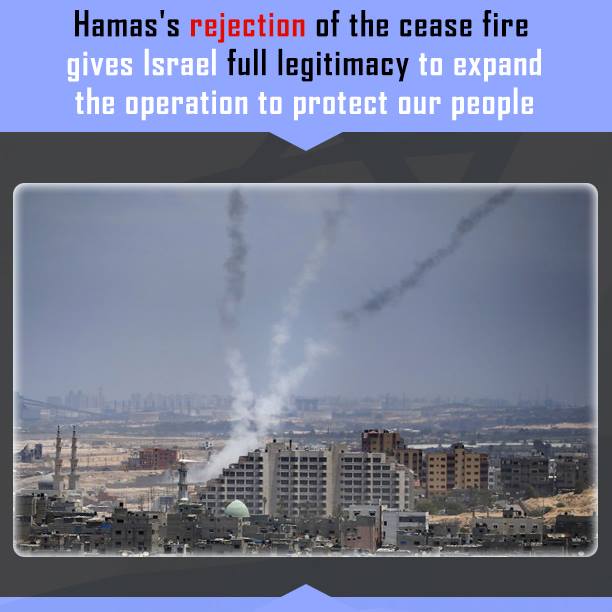
The Israeli government has cited rocket fire from Gaza as justification for its bombardment and assault on the narrow strip of land holding some 1.8 million Palestinians.
(image by
(Graphic from Prime Minister Benjamin Netanyahu's Facebook page))


The National Lawyers Guild (NLG), Center for Constitutional Rights, International Association of Democratic Lawyers, Arab Lawyers Union, and American Association of Jurists (Asociacion Americana de Juristas) sent a letter on Friday to Fatou Bensouda, Prosecutor of the International Criminal Court (ICC), urging her to initiate an investigation of war crimes, genocide, and crimes against humanity committed by Israeli leaders and aided and abetted by U.S. officials in Gaza. Under the Rome Statute, the ICC has the power to hold individuals criminally accountable for the most serious of crimes.

"In light of the extreme gravity of the situation in the occupied Gaza Strip, in particular the large number of civilian casualties and large scale destruction of civilian property, including schools, mosques and hospitals, and the ongoing incitement to genocide perpetrated by Israeli political figures and leaders, the [NLG] and endorsing organizations strongly urge the Office of the Prosecutor to use its power under Article 15 of the Rome Statute to initiate a preliminary investigation" of crimes within the ICC's jurisdiction.
"[Under the Rome Statute, an] individual can be convicted of a war crime, genocide or a crime against humanity . . . if he or she 'aids, abets or otherwise assists' in the commission or attempted commission of the crime, 'including providing the means for its commission,'" the letter reads.


"By transferring financial assistance, weapons and other military aid to Israel, members of the U.S. Congress, President Barack Obama and Defense Secretary Chuck Hagel have aided and abetted the commission of war crimes, genocide and crimes against humanity by Israeli officials and commanders in Gaza."

The letter states that on July 20, in the midst of criminal behavior, Israel requested, and the U.S. Defense Department then authorized, the transfer to Israel of ammunition from the War Reserve Stockpile Ammunition. And in August 2014, Congress overwhelmingly approved, and Obama signed, a $225 million payment for Israel's Iron Dome missile defense system.

"Israel's clearly disproportionate use of force against the 1.8 million residents of Gaza appears to have little to do with any claim of security," the organizations wrote, "but seems to be calculated to exact revenge against Palestinian civilians." The letter quotes statements of Israeli officials advocating vengeance against "the entire Palestinian people "and "calling for the internment of Palestinians in concentration camps in Sinai and the destruction of the civilian infrastructure in Gaza."


Allegations of War Crimes

The letter lists the following war crimes, and cites supporting factual allegations for each crime:

-willful killing (over 2,000 Palestinians, 80 percent civilians)

-willfully causing great suffering or serious injury (wounding nearly 10,000 Palestinians, 2,200 children)

-unlawful, wanton and unjustified extensive destruction and appropriation of property (tens of thousands of Palestinians lost homes, severe damage to infrastructure)

-willful deprivation of fair trial rights (450 Palestinians held without charge or trial); -intentional attacks against civilians or civilian objects or humanitarian vehicles, installations and personnel(bombing of numerous schools, UN places of refuge, hospitals, ambulances, mosques)

-intentionally launching unjustified attacks, knowing they will kill or injure civilians, damage civilian objects, or cause long-term and severe damage to the natural environment (use of 'Dahiya Doctrine' to apply "disproportionate force" and cause "great damage and destruction to civilian property and infrastructure, and suffering to civilian populations," as defined in UN Human Rights Council [Goldstone] Report). Israel virtually flattened the town of Khuza'a.

Allegations of Genocide

Article 6 of the Rome Statute defines "genocide" as the commission of any of the following acts with the intent to destroy, in whole or in part, a national, ethnical, racial or religious group: (a) killing members of the group; (b) causing serious bodily harm to members of the group; or (c) deliberately inflicting on the group conditions of life calculated to bring about its destruction in whole or in part.

The letter says, "In light of the fact that Palestinians in Gaza had no ability to flee for safety, it must be assumed the responsible Israeli officials knew that huge casualties and destruction of civilian property and infrastructure were certain during the massive bombardment by land, air and sea of the occupied Gaza Strip."


The letter also lists "the repeatedly inciting public statements made by Israeli officials before and during the course of Operation Protective Edge and the history of Israel's repeated bombardment of Palestinian refugee camps and populations in Lebanon and in Gaza" as evidence that "Israeli officials may be implementing a plan to destroy the Palestinian population, at least in part."

Allegations of Crimes against Humanity

Article 7 of the Rome Statute defines "crimes against humanity" as the commission of any of the following, when part of a widespread or systematic attack directed against any civilian population, with knowledge of the attack: (a) Murder; (b) Persecution against a group or collectivity based on its political, racial, national, ethnic or religious character; or (c) The crime of apartheid (inhumane acts committed in the context of an institutional regime of systematic oppression and domination by one racial group over another racial group, with the intent to maintain that regime).

The letter states, "Israeli forces have killed, wounded, summarily executed and administratively detained Palestinians, Hamas forces and civilians alike. Israeli forces intentionally destroyed the infrastructure in Gaza." It also says Israel keeps Palestinians caged in "the world's largest open air prison," and "controls all ingress and egress to Gaza, and limits " access to medicine and other essentials."

Finally, the letter cites arbitrary arrest and administrative detention; expropriation of property; destruction of homes, crops and trees; separate areas and roads; segregated housing, legal and educational systems for Palestinians and Jews; the illegal barrier wall encroaching on Palestinian territory; hundreds of illegal Jewish settlements on Palestinian land; and denying the right of Palestinians to return to their homeland because they are not Jews.

The signatories to the letter conclude that "[t]he initiation of an investigation would send a clear message to all involved either in committing or in aiding and abetting of the aforementioned crimes that they stand to be held personally accountable for their actions."


It remains to be seen whether the ICC will exercise jurisdiction in such a case since neither Israel nor the United States is a party to the Rome Statute. But if the ICC determines that Palestine can accede to the Rome Statute, the ICC could take jurisdiction over crimes committed by Israelis and Americans in Palestinian territory.

http://www.marjoriecohn.com
Marjorie Cohn is a professor at Thomas Jefferson School of Law and immediate past president of the National Lawyers Guild. She is author of 'The United States and Torture: Interrogation, Incarceration, and Abuse, and
Cowboy Republic: Six Ways the Bush Gang Has Defied the Law and co-author of Rules of Disengagement: The Politics and Honor of Military Dissent. Her anthology, The United States and Torture: Interrogation, Incarceration and Abuse. Her articles are archived atwww.marjoriecohn.com.

http://www.opednews.com/articles/Seeking-Accountability-for-by-Marjorie-Cohn-Accountability_Gaza-Invasion_ICC_Palestinian-140823-656.html

http://samotalis.blogspot.com/

21 August, 2014

Al-Zahar: Comparing Hamas with Islamic State 'a deception'

Al-Zahar: Comparing Hamas with Islamic State 'a deception'
'Israeli Prime Minister Benjamin Netanyahu making a connection between Hamas and the Islamic State is a deception, which aims to incite the world against Hamas...Hamas is a national resistance movement and its aim is to liberate Palestine'
Hamas's senior leader Mahmoud Al-Zahar said on Wednesday that comparing Hamas with the Islamic State is "a deception" that aims to "incite" the world against the Palestinian resistance movement, Egypt's Al-Mesryoon newspaper reported on Wednesday.
The newspaper quoted a statement by Al-Zahar that was broadcast by Al-Aqsa, a television channel close to Hamas, as saying: "Israeli Prime Minister Benjamin Netanyahu making a connection between Hamas and the Islamic State is a deception, which aims to incite the world against Hamas."
Al-Zahar explained: "Hamas is a national resistance movement and its aim is to liberate Palestine."
He affirmed that his movement defends the interests of its people, who have been under a brutal Israeli occupation for decades in addition to the eight-year-long siege of the Gaza Strip, preventing Palestinians in Gaza access to basic needs like food, medicine, electricity and free movement.
During a press conference earlier on Wednesday, Netanyahu had made the claim that, "Hamas is similar to the Islamic State."
On Tuesday, a 24-hour truce extension was broken and Israel's attacks against the Gaza Strip resumed. Some hours before the end of the truce, the Israeli occupation claimed that rockets were fired from Gaza towards Israel and, thus, it responded with more airstrikes.
The number of Palestinians who have been killed since the beginning of Israel's latest war on Gaza, launched on 7 July, has now reached 2,068, with more than 10,250 wounded.


http://samotalis.blogspot.com/

09 August, 2014

Maldivians to take Gaza fundraising efforts to new heights

Maldivians to take Gaza fundraising efforts to new heights


Maldivians to take Gaza fundraising efforts to new heights thumbnail
Maldivian efforts to assist the people of Palestine will culminate in an unprecedented 33 hour telethon aired across multiple participating broadcasters.
Numerous media organisation have initiated a telethon titled ‘I will also help’ to raise funds for victims of the ongoing Israeli attacks on Gaza. It will air from 2:30pm on Friday (August 8).
The organisers will also assist in arranging a joining of hands across the capital Malé at 5pm on Saturday, while the fundraising – with over US$350,000 already in the Help Gaza Fund – is set to grow as both state and private companies urge staff to donate wages to the fund.
All TV channels and radio stations taking part in the telethon will air the same live program with content – produced by a joint content committee - on the current situation in Gaza to be broadcast through out the programme.
Live updates of donations and details of fundraising and solidarity events organised by councils and NGOs across the country will also feature.
Solidarity
This week Maldives Customs Service and Maldives Ports Limited jointly opened a joint fund where employees of both institutions agreed to donate one day’s basic salary. Faafu Atoll Hospital has also decided to join this campaign.
In addition to one day salaries of their employees, newspaper Haveeru has decided to donate the total revenue generated in advertisement on their online and print news this Thursday (August 7). The paper hopes that this will allow people to donate by placing advertisements on the paper as well.
The state owned State Trading Organization (STO) has announced it will donate a percentage of its two major shops’ sales on on August 8 and 9, five percent from STO Home Improvement, and two percent from STO Super Mart.
STO is also coordinating with the media telethon group for the joining of hands event during which people will stand holding hands across Boduthakurufaanu Magu in Malé starting from the tsunami monument.
Ahmed ‘Hiriga’ Zahir, an organiser and President of the Maldives Journalism Association, requested everyone dresses in black for the event to show that “we are taking part in their sorrow”.
“Remember how we felt when the tsunami hit the Maldives and how we requested foreign aid? Now our brothers and sisters in a situation where they need our help. I request everyone to donate to the best of their ability for this cause,” he said.
The telethon group is also selling fifteen ‘Help Gaza’ t-shirts for MVR100,000 each. Two have already been booked – one by the STO for President Abdulla Yameen and another by Kooddoo Fisheries Maldives Limited for the first lady.4
Joining of funds
After the Adhaalath Party endorsed the telethon, both parties have agreed to join their funds, with the party’s Help Gaza Fund being pooled with the telethon collection from Friday.
The Help Gaza Fund has received over MVR5.48million (US$355,600), the party said today. Collection of funds is on halt for now and will begin again with the the telethon on Friday, explained an Adhaalath spokesperson.
The donations from the joint fund will be handed over to the Qatar Red Crescent Society (QRCS) – chosen because they have worked with Adhaalath in previous fund raising events such as the 2010 Pakistan Relief Fund to help flood victims and the 2009 Gaza Fund.
QRCS has assured that these fund will reach the people of Gaza in the form of food and medicine through their relief efforts in area.
Meanwhile, the Maldivian Red Crescent (MRC) are also raising funds in response to an emergency appeal for US$14.7 million by the Palestine Red Crescent Society on July 14. The MRC Palestine Relief Fund was established on July 20 will continue collecting until August 15.
Funds will be raised through MRC Emergency Relief Fund bank accounts, donation boxes and door-to-door collection across the country.

http://samotalis.blogspot.com/

24 July, 2014

Ramadan in Gaza: life under missile-fire


Ramadan in Gaza: life under missile-fire

More than 100 have died – often women and children in their own homes – and food prices are rising fast as supplies dry up


Peter Beaumont in Gaza City

The Guardian,

Palestinians flee an air strike on a house in Rafah that killed five people and wounded 15 others on the fourth day of the Israeli military campaign. Photograph: Eyad Al Baba/Anadolu Agency/Getty


In Gaza's largely deserted streets, the first thing you notice is the absence of children.

The beach, usually crowded on Friday afternoons, is empty save for a handful of fishermen casting hand nets into the surf next to the harbour wall.

Al-Azhar park – next to the university of the same name – and Barcelona park with its climbing frames, lawns and basketball courts, are empty.

The few children who are outside play in the sheltered spaces between tall apartment blocks and the narrow lanes of the poorer neighbourhoods, a few feet from their doors under the watchful eyes of their parents: places deemed safer from bomb blasts.

It is the fourth day of Israel's intensive bombing campaign of the Gaza Strip, and more than 100 Palestinians have been killed, many of them children. More than 670 are injured. Families here have settled into a tense wartime regime, a daily routine hard-learned from Israel's previous military campaigns of 2008-09 and 2012.

Unlike Israel, there are no bomb shelters in Gaza. There are no sirens to warn of incoming missiles and no Iron Dome to shoot them down. The only warning, and one provided only intermittently, is that from those dropping the bombs – supplied by phone, text or a warning shot to the roof.

Under the ever-present hum of circling drones, squeal of jets, bomb-blasts and the thud of naval gunfire from the sea, most women and children are stuck indoors, often in buildings without electricity.

These families have been caught in a tragic catch-22. Afraid to leave their homes when the Israeli warplanes do drop their bombs on Gaza's neighbourhoods, it is the women and children sheltering in the buildings where they instinctively feel safest who are dying.

Israel has said it is training its missiles on Gaza's homes – a practice the United Nations Human Rights Office says may violate international law – because Hamas and other militants are hiding inside.

"We have received disturbing reports that many of the civilian casualties, including of children, occurred as a result of strikes on homes," Ravina Shamdasani, a UN spokeswoman said on Thursday. "Such reports raise doubts about whether the Israeli air strikes have been in accordance with international humanitarian law and international human rights law."

The Israeli prime minister, Binyamin Netanyahu, has rejected the criticism of international and local human rights groups and vowed to continue with the campaign. "No international pressure will prevent Israel from continuing its operation in Gaza … The leaders of Hamas are hiding behind the citizens of Gaza, and they are responsible for all casualties," he said.

For the 1.8 million people living in Gaza, this means that long Ramadan days – from before dawn until the late bedtime traditional during the fasting month – will continue to be defined by limited exposure to the open air.

Gaza City's central Firas market is usually packed with shoppers shoulder to shoulder, looking for fruit and vegetables after noon prayers. This Friday a few people were bustling along its lanes. Hamdi Haboush, 63, sat outside the hardware store where he sells brush heads and squeegees, spice racks and spades. "I haven't had any customers at all today," he said. "I only opened because I couldn't bear staying in the house. There are 50 of my family in our building, including twenty grandchildren.

"It's only really me who is going to early prayers at the moment [at four in the morning]. But it's the most frightening time for bombs so I walk close to the walls on my way to mosque.

"Otherwise no-one is going out. There's no work and nothing to do. Nowhere safe to go. Everyone is in a state of panic wondering when a bomb will fall.

"We have two metres square of space where the younger children can play. Last night some of the grandchildren came to me and said: 'Why are you going to open your shop? It's scary.' But I have to come out to change my mood."

Other men standing or sitting by their empty shops and stalls said the same. There is no money to be made – only relief from households going "crazy".

If, as Haboush says, early morning prayers are quiet, a steady stream of men and older boys filed in to the main mosque in Radwan for Friday prayers.

Mahmoud Karazem, 30, arrived late and in a hurry. He has grown used to the bombs over the years and different campaigns: "It's normal." Life under advanced missile-fire is not yet normal for his wife and two young toddlers.

"My wife is at home with the children. They are one and a half and almost three. I try to reassure them but when a bomb explodes it bursts the bubble. I cuddle them to get them used it, but sometimes it doesn't work."

The imam began his sermon with a message to worshippers that they were engaged in a fight of "good against evil". Ramadan "is a time of victories" he said before condemning the complicity of America and the international community and "the silence of the Arab world".

Mahmoud Khalija went to buy groceries after midday prayers. A worker at Gaza City's Shifa hospital, he said he is attempting to go about his life as "normally as possible".

"My wife is going to work too," he said. "Our older children stay at home with the youngest. The prices are the biggest problem. There is no fish," he added, indicating a shuttered fish stall. "And because it is so hard for the farmers to harvest and bring their produce to the market, some prices have quadrupled."

Others who had ventured out explained the judgment call: roads exposed to the sea, and therefore to Israel's naval gunships, are to be avoided. Roads bordering farmland where rockets are launched, are driven through quickly, if at all.

In Gaza, wealth cannot inoculate you from fear. In affluent neighbourhoods, where the buildings are taller and more widely spaced, the sound of the dropping missiles rings more loudly and clearly than in the huddled, poorer neighbourhoods and refugee camps. They are also closer to the naval boats pounding the coast with artillery fire.

In Tal al-Hawa, a neighbourhood hit hard in the 2008-09 conflict, Hazem Farwana, 38, a baker, is making Ramadan pancakes. He and his son Samir, 12, sell them for a £1.50 a kilo from a stall in front of a falafel takeaway.

Pancakes are the treat of any Iftar meal at the end of a day of fasting. They are served with nuts, cheese or dates and normally eaten before families go out visiting, sitting up late into the night. But Farwana and his wife have not gone visiting this week: "We are not living a normal life.

"People are stuck indoors. All they can do is eat. I have four children under 16 – I won't let them go too far from home."

As he spoke, a bomb exploded in the distance, close enough for a shockwave to rattle the window frames overhead.

Suddenly philosophical, Farwana added: "If I am going to die then I will die. I can die in the open as easily as I can indoors."
http://samotalis.blogspot.com/

Palestinians in Gaza struggle this Ramadan

Palestinians in Gaza struggle this Ramadan

Grappling with unpaid wages and a struggling economy, Palestinian families have little to celebrate during holy month.


Fares Akram

Gaza City - On top of the Abu Amin Abu Shawish family’s Ramadan breakfast table sat only four bowls ofmaloukhieh soup, two dishes of white rice, and some lemons and green peppers.

"The meat was eaten yesterday. This is the leftover from the day before," said Abu Amin, 50, who provides for an extended family of 14 people, all living in a makeshift home in southeast Gaza City. The family’s economic situation during the Islamic holy month of Ramadan "is very bad" compared to previous years, Abu Amin said.

In the past, he distributed cement to several construction sites and projects in the Gaza Strip every day. The cement, like most other construction materials, was being smuggled into the Palestinian territory from Egypt. Last summer, the Egyptian army shut down most of the smuggling tunnels, cutting off the lifeline that had prevented Gaza's economy from near-total collapse.

More than 50,000 people who worked in industries related to the tunnels, and more than 150,000 professionals and artisans whose jobs relied on construction materials, have now joined the ranks of Gaza's jobless. In the first quarter of 2014, approximately 180,000 Palestinians in Gaza were unemployed, up from about 160,000 unemployed in the last quarter of 2013.

"In the past, I used to make from 100-150 shekels [$29-44] distributing cement a day, and my son worked on a [horse-drawn] cart also in distributing, making another 50 shekels [$15]," said Abu Amin, whose house is made of salvaged concrete bricks and rusted, corrugated aluminium. "We had a new meal every day."

"Now, we can't find 15 shekels [$4] to feed the horse," he continued.

RELATED: Gaza - Life under siege

While mosques are full for most of the day, at night people in Gaza are preoccupied by Israeli air strikes on the besieged Palestinian territory. Israel says the attacks are a response to rockets fired from Gaza; they have also come after Israel accused Hamas of orchestrating the kidnapping and killing of three Israeli settler teenagers near the West Bank city of Hebron last month. On Saturday, Israel launched 10 separate strikes on Gaza.

Meanwhile, Abu Amin's family only received one parcel of food from a charity operating in Gaza - beans, cooking oil, rice, sugar, and other basic staples - for Ramadan, compared to four parcels at the same time last year.

Charities in Gaza are struggling with increased demand for help, said Ahmed al-Kurd, the coordinator of humanitarian aid for several local organisations in Gaza. Last year, the organisations were able to support 60,000 families. This year, the number of families who applied for food assistance increased dramatically to 100,000, while the charities have enough money to provide for 30,000 families, al-Kurd said.


I came here to buy Ramadan goods for my family and my [married] daughter, but I don’t think I will be able to buy all the things I wanted.

- Mohammed Qanita, 44, electrician


Due to international political pressure, "hundreds of financial transfers [from Muslim and Arab donors] did not arrive," he told Al Jazeera. "We can't carry out our work as needed."

High prices and a lack of purchasing power also mean that many people wander through Gaza’s markets, but few actually buy.

"Prices are high this year," said electrician Mohammed Qanita, 44. "I came here to buy Ramadan goods for my family and my [married] daughter, but I don’t think I will be able to buy all the things I wanted."

At al-Zawya market in the old quarter of Gaza City, fewer Ramadan ornaments were visible than in previous years, and though the market was busy, the majority were not buying.

Alaa Masoud, who was selling cheese, jam, tahini halva, and other Ramadan staples, said that with the closure of the tunnels between Gaza and Egypt, much of the goods must be imported through Erez, an Israeli-controlled commercial crossing point.

"This has risen from 18 to 23 shekels [$5-7]," he said, pointing to a yellow Gouda cheese. An Egyptian-made feta cheese saw a six-shekel [$1.75] increase. "People have no money; workers are laid off, crossings are closed, no salaries," Masoud said. "At this time last year, I was selling 100,000 shekels [$29,250] a day. Now, I only sold for 60,000 [shekels, about $17,500]."

RELATED: Salary crisis imperils Palestinian unity

The West Bank-based Palestinian Authority has not yet paid the salaries of its 70,000 employees in the Gaza Strip. PA employees are usually paid the first week of every month, however the PA said the salaries will be late because Israel has not yet transferred Palestine's tax revenues.

Over the past eight months, the Hamas government, which was dissolved in June with the formation of a Palestinian national consensus government, has provided its employees with only small portions of their basic salaries. Employees of the former Hamas government, estimated at about 42,000 workers, still have not collected paychecks for April and May.

Read more of our coverage on Palestine


"We are looking for every way at least to provide them with a minimum income. There are attempts to provide employees with smaller payments from charities and benefactors. This is what we can do for them in Ramadan," Salah al-Bardaweel, a senior Hamas official in Gaza, told Al Jazeera.

While Abu Salem, a 35-year-old traffic cop, has not been paid for more than 50 days, he was still working under the hot sun.

"I have four children and it's their right to enjoy [themselves] like children of other families," he said, without giving Al Jazeera his full name. Abu Salem added that he wouldn’t be able to buy "fresh meat, chicken, qatayef, candies and sweets for Ramadan".

Maher al-Tabba, an economist based in Gaza, said that both sets of Palestinian public servants - in the West Bank and Gaza Strip - hold most of the purchasing power. "Markets often rely on the salaries of [Palestinian Authority] and Gaza employees."

He told Al Jazeera that the delay in paying the employees caused a sharp decrease in sales. "We are talking about 180,000 to 200,000 jobless people… This is a disastrous situation," he said.

http://samotalis.blogspot.com/

03 August, 2013

ElBaradei to Washington Post: Israel has chance for 'real peace' with Egypt

ElBaradei to Washington Post: Israel has chance for 'real peace' with Egypt
Egypt's interim vice president expresses support for Kerry's efforts towards a two-state solution and says Israel has opportunity for normalized relations with post-Mubarak Egypt - if they change policy on Palestinians.

By Haaretz | Aug. 3, 2013 | 1:54 PM


Mohammed ElBaradei. Photo by AP
RELATED ARTICLES
U.S. struggles to cope with the crisis in Egypt
By Zvi Bar'el | Aug. 3, 2013 | 12:49 AM | 2

In an interview with the Washington Post on Friday, Egypt's interim vice president Mohamed ElBaradei asserted his support for U.S. Secretary of State John Kerry's efforts towards a two-state solution to the Israeli-Palestinian conflict, and a "real peace" between Egypt and Israel.

El-Baradei, who is the former head of the International Atomic Energy Agency and Nobel Peace Laureate, became interim vice president following the ousting of President Mohammed Morsi last month. He called to halt the violence and dialogue with the Muslim Brotherhood, insisting they should be part of the political process.
Asked about Egypt's relationship with Israel, Baradei asserted that Israel now has the opportunity to forge a peace agreement with a post-Mubarak Egypt – but conditioned that upon a change in policy towards the Palestinians.

"We need to make sure that there is really a real peace with the Israelis. They have an opportunity, frankly, right now. In the past, they had peace with Mubarak, not with the Egyptians. Now is an opportunity for them, and I hope they grab that opportunity to have a peace with the Egyptians. But that requires that they make certain major adjustments to their policy with the Palestinians."

ElBaradei also he supports the renewal of negotiations between Israeli and Palestinians led by Kerry, and that it could open the door for comprehensive peace in the Middle East. "Kerry’s talks are based on a two-state solution and all the basic pillars of Bill Clinton’s outline done in the last week of his presidency. Once we get that, then I think the road is open for normalization of relations with Israelis and a comprehensive peace in the region," ElBaradei told the Washington Post.
http://samotalis.blogspot.com/

25 June, 2013

Gaza Palestinians give hero's welcome to their 'Arab Idol'


Gaza Palestinians give hero's welcome to their 'Arab Idol'


By Nidal al-Mughrabi
GAZA | Tue Jun 25, 2013 10:43am EDT

(Reuters) - Tens of thousands of joyous fans turned out on Tuesday to welcome "Arab Idol" Mohammed Assaf on his return to the Gaza Strip and the song contest winner appealed for harmony among divided Palestinians.

The fresh-faced 22-year-old from humble roots in a Gaza refugee camp has endeared millions of voting television viewers with his Palestinian patriotic anthems and folk songs.

Police from the Islamist Hamas movement that controls Gaza could barely hold back the crowds that waited for the grey-suited Assaf outside the gate of the territory's Rafah border crossing with Egypt.

His car drove through a sea of cheering Palestinians, some of whom climbed electricity poles and took to rooftops for a better glimpse of the young star, who was declared the winner of the popular pan-Arab competition in Beirut on Saturday.

"Thanks everyone, without you I would have never won," Assaf said at a news conference after his arrival.

He returned to a Palestinian enclave where political rifts run deep. Hamas, which won a 2006 parliamentary election, seized control of Gaza from forces loyal to Western-backed President Mahmoud Abbas's Fatah party in 2007.

"I call for an end to division and I will continue to call for unity in all speeches I make," Assaf said.

Signaling its tacit endorsement of the singer, Hamas - which frowns on non-Islamic songs and the Western-style glitz of TV talent shows - sent officials from the Gaza-based Ministry of Culture to the border crossing to welcome him.

Fatah officials were also there, and many in the crowd waved the mainstream movement's yellow flags.

After his victory, Assaf was named by the United Nations as its first youth ambassador to Palestinian refugee camps in the territories and in neighboring countries. He is expected to visit the West Bank to perform.

"We won hope," said Abu Khalil, a 65-year-old Gaza resident. "I hope political leaders can learn something from Assaf - that love unites people, not hatred."


(Editing by Jeffrey Heller/Mark Heinrich)


http://samotalis.blogspot.com/

23 October, 2012

Qatar emir visits Hamas-run Gaza Strip

Qatar emir visits Hamas-run Gaza Strip


Hamas Prime Minister Ismail Haniyeh walks with the Emir of Qatar Sheik Hamad bin Khalifa Al-Thani (front R) during a welcoming ceremony at the Rafah border crossing with Egypt in the southern Gaza Strip on Tuesday. (Reuters)


REUTERS
RAFAH, Gaza Strip: The Emir of Qatar entered the Gaza Strip on Tuesday for a visit that broke the isolation of it Islamist rulers, Hamas, but disappointed Israel and mainstream Palestinian leaders in the West Bank.
Sheik Hamad bin Khalifa Al-Thani crossed into Gaza from Egypt at the head of a large delegation on what is billed as a humanitarian visit to inaugurate $250 million worth of reconstruction projects.
It was the first trip by a head of state to Gaza since 1999 and the emir was given a red-carpet welcome by Hamas Prime Minister Ismail Haniyeh, who declared it a historic day for the enclave, which backs on to the Mediterranean sea.
The Western-backed Palestinian Authority of President Mahmoud Abbas, Hamas’s arch-rival, said it hoped the visit would not undermine efforts to rebuild Palestinian unity or signal approval for a separate Palestinian territory.
An Israeli foreign ministry spokesman said it was “astounding” that Qatar was taking sides, noting that the emir “has never dignified the PA with a visit.”
Hamas seized control of the enclave in 2007 after a brief battle with the armed wing of Abbas’ Fatah movement. It refuses to renounce violence or to recognize Israel’s right to exist and it is ostracized by the West as a terrorist organization.
Haniyeh denies Hamas is seeking to create its own state in the tiny enclave, which is under partial blockade by Israel, with Egypt helping to enforce the Jewish states’ restrictions.

The emir and his large delegation were greeted by a Hamas honor guard and Palestinian and Qatari flags decorated the route on the main road north to the city of Gaza, a key highway that Qatar will rebuild.
His visit coincided with another round in the low-level conflict between Israel and Hamas. An Israeli officer was badly injured by an explosion on the Gaza border and Prime Minister Benjamin Netanyahu promised a “strong response,” which often comes in the form of Israeli air strikes.
The emir was due to make a public appearance in one of Gaza’s largest soccer stadiums, and security arrangements have been in place for days ahead of the visit, seen by Hamas as a victory after five years of isolation.
Western-allied Gulf Arab states are trying to lure Hamas away from its alliance with Iran, whose nuclear energy program has raised the prospect of a war with Israel.

Qatar’s emir has met Israeli leaders in the past and is working hard to boost the diplomatic clout of his small country. He has also previously sought to mediate between Hamas and Fatah to end the divisions that have weakened the Palestinian cause.
Hamas says his trip would mark the beginning of the end of Israel’s blockade policy.

http://samotalis.blogspot.com/

09 September, 2012

Palestinians seek to amend economic accord with Israel

Palestinians seek to amend economic accord with Israel

Related News

Policy paralysis scuppers Palestinian economic dream
Wed, Sep 5 2012
Security chief slain in restive Palestinian city
Wed, Sep 5 2012
Iran's policies attacked by U.N. head, Egyptian leader
Thu, Aug 30 2012
Israel court tells settlers to evacuate outpost by Tuesday
Wed, Aug 29 2012
Court clears Israeli army over death of U.S. activist
Tue, Aug 28 2012

By Ali Sawafta

RAMALLAH, West Bank | Sun Sep 9, 2012 12:03pm EDT

(Reuters) - The cash-strapped Palestinian Authority said on Sunday it has asked Israel to consider overhauling a key economic agreement that has determined its customs and tax rates for the past 18 years, in the wake of street protests against high prices.

U.N. agencies and Palestinian economists say the economic sections of the Oslo interim peace deals, outlined in the Paris Protocol of 1994, have been implemented by Israel selectively and mostly to its benefit.

"Eighteen years of the Paris economic agreement have become a heavy burden on the Palestinian people and led to very difficult financial and economic conditions," Palestinian Civil Affairs Minister Hussein al-Sheikh told Reuters.

The aid-dependent Palestinian Authority (PA), which exercises limited self-rule in the occupied West Bank, has also been plunged into its deepening financial crisis by a drop in assistance from Western and wealthy Gulf backers.

The Paris Protocol maps out an economic blueprint for a customs union between Israel and the Palestinian territories and pegs value added tax to Israeli rates, now at 17 percent, effectively blocking any steep price cuts in the West Bank.

In another blow to the Palestinian economy, provisions allowing the Palestinians to make free trade agreements with other states and mandating access to Israeli markets have not transpired.

Last week, days of street protests in the occupied West Bank against high living costs led Palestinian Prime Minister Salam Fayyad to say on Thursday he would be willing to resign if there was "a real public demand" that he step down.

Sheikh said he had sent a letter, at President Mahmoud Abbas's request, to Israel's Defence Ministry "demanding they open" the Paris accord and offering to form joint technical committees to negotiate its amendment.

Asked about the Palestinian move, Amos Gilboa, a senior Israeli Defence Ministry official, told Israel Radio: "We have to examine exactly what they are proposing and to see if it's practical."

The Palestinian government is grappling with a recurring budget deficit and external debt, both hovering above a billion dollars or nearly a fifth of gross domestic product.

Foreign aid is now lagging, as a hoped-for $1.1 billion in 2011 reached only $750 million, as pledges from Gulf states in particular fell short.

Some economists say economic growth could be as low as 3-4 percent this year, and with a fifth of the population unemployed, prospects for many of the West Bank's 2.5 million Palestinians are declining.

SALARY CRUNCH

The Palestinian Authority's cash crisis has delayed salary payments for some 153,000 civil servants several times this year.

Perhaps worried the stalling economy will unleash unrest in the territories, Israel is showing flexibility.

After a year of negotiation, Israel agreed this summer to streamline the handling of import duties it collects on goods bound for the Palestinian market - duties worth some $100 million a month, around two-thirds of PA income.

But Samir Abdullah, director general of the Palestine Economic Policy Research Institute, said the Paris accord need to be renegotiated to free Palestinians from their dependence on Israeli oversight and allow them more leeway to trade abroad.

"Israel has not committed to open its market to the Palestinians while the Palestinian market has remained open to it," he told Reuters.

Mechanisms for economic dialogue between Israel and the Palestinians were mandated by the interim Paris deal, which like the Oslo accords, was meant to last for only five years pending a final peace agreement between Israel and the Palestinians.

A 2000 to 2005 Palestinian uprising led Israel to tighten restrictions on the movement of Palestinian goods and statehood negotiations have been frozen since 2010 in a dispute over Jewish settlement construction.

(Writing by Jeffrey Heller in Jerusalem, Additional reporting by Noah Browning in Ramallah; Editing by Sophie Hares)


http://samotalis.blogspot.com/

02 September, 2012

Israel Evacuates West Bank Settler Outpost

Israel Evacuates West Bank Settler Outpost
Jewish settlers speak to the media after leaving their homes in the West Bank outpost of Migron September 2, 2012.

Robert Berger

September 02, 2012
JERUSALEM – Israel has evacuated Jewish settlers from an outpost in the occupied West Bank after a long legal case.

Some 300 Jewish settlers gathered their belongings and left their homes in the West Bank outpost of Migron. The evacuation was ordered by Israel’s Supreme Court, which ruled a year ago that the outpost was built on Palestinian-owned land and was illegal.

Most of the settlers left peacefully, but some youths who had barricaded themselves in a trailer home were dragged away by Israeli police.

The settlers accused the Israeli government of betraying the biblical "Land of Israel."

Migron resident Itai Chemo said Israel’s leadership has failed the Jewish people, but he saw a silver lining. He said that in place of Migron, two more settlements will be established.

Israel's government has already built temporary housing on West Bank land for the evacuated settlers, and it has promised that a permanent community will be built nearby.

For the Palestinian landowners, it was the end of a long legal battle and struggle.
Abed al-Mounem Mouatan said it deeply pained him every day as he saw the Migron settlement from his house. He said he never thought that he would see the day when the settlers would leave.

But Palestinian officials say this small evacuation is not enough.

The Migron case involved a settlers' outpost that had not been authorized by the Israeli government. Palestinians and much of the international community deem all Israeli settlements in the West Bank as illegal.
Israel says it expects to keep major settlements in any future peace deal with the Palestinians.

http://samotalis.blogspot.com/

07 August, 2012

Palestinians use tradition to protect land

Palestinians use tradition to protect land


AGENCE FRANCE PRESSE

EIN YABRUD, Palestinian Territories: It has taken four years for Amer Dahabreh to build a traditional stone wall around his land, in what appears to be the ideal solution for protecting it from Jewish settlers.
Within the safety of this stone enclosure, this 60-year-old farmer grows apricots, grapes, peaches and courgettes in the village of Ein Yabrud, which is overlooked by the neighboring Jewish settlement of Ofra.
The village is located in Area C, an area under total Israeli control which comprises some 60 percent of the West Bank.
“The idea of these enclosures was handed down to us by our ancestors; they were put up to protect the land,” explains Dahabreh, who owns an 80-dunum (eight-hectare/20-acre) plot of land.

“I think that the moment has come for all Palestinians to take an interest in building them because it is the ideal solution,” he told AFP.
In the West Bank, Palestinian farmland that appears to be left untended can become a target for Jewish settlers looking to expand a nearby settlement or for creating a new outpost. Legal efforts to retrieve such land are often lengthy and rarely result in the landowners’ favor, so for Dahabreh, erecting a stone boundary is a fundamental way to both mark out and protect his territory.
“If all Palestinians were to fence in their land this way, we might be able to protect it from settlement,” says Dahabreh, who spent 10 years living in the United States. Much of the West Bank’s farmland is strewn with rocks and boulders, making it perfect for for building such enclosures, which are sometimes also surrounded by a barbed wire fence or a makeshift metal fence.
Palestinians living in Area C are banned from using cement by the Israeli Civil Administration, a unit of the defense ministry which is responsible for all civilian affairs in the West Bank.
But crucially, these traditional boundaries, which are basically dry stone walls, do not require cement.
“They prevent us from using cement so that’s why we use these old stones,” Dahabreh says.
Abdullah Abdullah, an official at the Palestinian governmental department that handles issues relating to Jewish settlement and the separation barrier, said the Civil Administration has recently stepped up its restrictions on construction in Area C.

“Following the recent European report on Palestinian development in Area C, Israel has imposed restrictions like a ban on using cement without permission, and has also introduced new taxes,” he told AFP.
In May, EU foreign ministers expressed concern about “worsening living conditions” for Palestinians in Area C and denounced the “serious limitations” imposed on Palestinian development there in a move which sparked Israeli anger. “The EU will continue to provide financial assistance for Palestinian development in Area C and expects such investment to be protected for future use,” a ministerial statement said, referring to the widespread demolition of Palestinian homes in the sector.
The Civil Administration did not respond to AFP requests for comment.
Dahabreh’s neighbor, Nader Al-Taher, has also built a traditional stone wall around a nine-dunum patch of land belonging to a Palestinian who is living in the United States.
Every day, he comes to water the plot from a well which is also on the land.
“The owner doesn’t want to get involved in legal disputes (with the Israelis); he has spent a lot of money to preserve his land,” says Taher, explaining that it took the workers 70 days of hard labor, with the help of a bulldozer, to gather all the rocks.
Statistics published in 2011 by the United Nations humanitarian agency OCHA show that Palestinian construction was only permitted in one percent of Area C, with a complete ban in force in 70 percent of the sector and very limited in the remaining 29 percent.
Around 150,000 Palestinians live in Area C alongside some 300,000 Jewish settlers out of a total of the 340,000 Israelis who lives in settlements across the West Bank, OCHA statistics show.
Dahabreh says the local settlers from Ofra settlement were less than impressed with his stone wall project, and tried to dissuade him by firing in the area as he was building it.
“I wasn’t afraid of them,” he said.
“On the contrary, I continued working on my land because I feel that this is the only way to protect it.” http://samotalis.blogspot.com/

04 July, 2012

Was Yasser Arafat poisoned with Polonium?

Was Yasser Arafat poisoned with Polonium? Lab tests find 'unexplained, elevated' traces of radioactive substance on leader's clothes

Polonium traces 20 times the dose needed to kill a human are found on Palestinian leader's underwear
Traces of element also found on leader's headscarf and toothbrush

Arafat died in Paris hospital in 2004 from mystery illness
Widow says his body should now be exhumed to investigate test results
Same radioactive substance also killed Russian dissident Alexander Litvinenko in 2006

By CHRIS PARSONS


Conspiracy: Yasser Arafat died in a Paris hospital from a mystery illness in 2004

The late Palestinian leader Yasser Arafat may have been assassinated with a lethal dose of the radioactive substance polonium, scientists have claimed.

Arafat died in 2004 from a mystery illness, amid theories that he was killed at the hands of Israeli spy agency Mossad.

But a new investigation has concluded that a urine stain on Arafat's underwear had traces of Polonium-210, the highly radioactive substance which killed Russian dissident Alexander Litvinenko six years ago.


The 75-year-old's widow, Suha Arafat, has called for her late husband's body to be exhumed after the Al Jazeera investigation found the traces on clothes he wore in his final days.


Previous theories had speculated that Arafat, who died in a Paris hospital in November 2004, had contracted cancer, cirrhosis, or even HIV.

But tests carried out by the Institute de Radiophysique in Lausanne, Switzerland, showed that Arafat's underwear registered a level of 180 millibecquerels of Polonium-210, more than 20 times the dose to kill an average human being.

Dr Francois Bochod, the director of the institute, confirmed to Al Jazeera that there had been an 'unexplained, elevated amount' of polonium found on the former leader.


More...
Spy chiefs issue warning after it's revealed Russian friend of Vanessa Redgrave is the target of another murder plot
Tensions escalate in Middle East as Iran tests long-range ballistic missiles capable of hitting Israel
Iran, the West Bank and the Arab Spring: The big questions hanging over the Middle East

The Al Jazeera documentary revealed that Polonium was found on Arafat's underwear, kaffiyeh headscarf, and even his toothbrush.

Al Jazeera had sent Arafat's clothes to the institute to test them, after obtaining them from his widow as part of a nine-month investigation into his death.

SCROLL DOWN FOR VIDEO


Investigation: Arafat's widow Suha Arafat, pictured here alongside then Palestinian Minister of Foreign Affairs, Nabil Shaath (left) and then French Prime Minister Jean Pierre Raffarin, says her husband's body should be exhumed following the lab results


Many have speculated that Arafat, whose West Bank grave is pictured here, was killed by an Israeli spy agency

POLONIUM: THE SLOW KILLER


Those exposed to a lethal dose of Polonium, usually by ingesting it, die within 2-3 months.


In most cases there are no serious symptoms for a week after being exposed, but nausea and fatigue would set in soon after.


After ingestion, Polonium affects the liver, kidneys, spleen, bone marrow, and gastrointestinal tract.


Serious illness would not be expected for a month, due to the amount of time it takes to accumulate dangerous internal exposures.


As the severity of the exposure develops in the body, victims usually lose hair, and the lining of the gastrointestinal system is destroyed.


This later leads to severe diarrhea, intestinal bleeding, loss of fluids, and disturbance of electrolyte balance.


Though it takes 5-6 weeks to seriously affect most, the symptoms of Polonium poisoning contrast to the case of Litvinenko (above), who fell ill the day after he was exposed.


The Russian died 23 days after being exposed, an indication that he was poisoned with many times the required lethal dosage.

Bochud said the only way to confirm the findings would be to exhume Arafat's body to test it for polonium-210.

'But we have to do it quite fast because polonium is decaying, so if we wait too long, for sure, any possible proof will disappear,' he told Al Jazeera.

It emerged today that Palestinians are ready to accept a medical examination of Arafat's body if his family agrees, according to a Palestinian official.


The comments from Tawfiq Tirawi, who led a Palestinian probe into Arafat's death, came just hours after the Al-Jazeera investigation showed the Palestinian leader might have been poisoned with the radioactive substance polonium.


The official told AP: 'After the Al-Jazeera broadcast I met today with president (Mahmud) Abbas and recommended accepting an analysis of the body of the martyr president Arafat, and Abbas for his part agreed on the condition that the family... accepts.'


Polonium was found to have caused the death of former Russian spy Alexander Litvinenko in London in 2006, and he was assumed to have been deliberately poisoned.

Arafat's widow Suha said she would ask for Arafat's body - buried in the West Bank town of Ramallah, seat of the Palestinian self-rule authority - to be exhumed.

Speaking at the end of the documentary, aired on Al Jazeera's English and Arabic channels, she said: 'We have to go further and exhume Yasser Arafat's body to reveal the truth to all the Muslim and Arab world.'

Arafat led the Palestinian Liberation Organisation's fight against Israel from the 1960s but signed a peace agreement with the Jewish state in 1993 establishing Palestinian self-rule areas in the West Bank and Gaza Strip.

His mysterious death came four years into a Palestinian uprising, after years of talks with Israel failed to lead to a Palestinian state.

French doctors who treated Arafat in his final days could not establish the cause of death.

French officials refused to give details of his condition, citing privacy laws, fuelling a host of rumours and theories over the nature of his illness.

Read more: http://www.dailymail.co.uk/news/article-2168632/Lab-tests-unexplained-elevated-traces-radioactive-substance-Yasser-Arafats-clothes.html#ixzz1zfIjCBQd


http://samotalis.blogspot.com/

26 June, 2012

Putin praises Palestinian leader Abbas


Putin praises Palestinian leader Abbas

Mohammed Daraghmeh
AP

Russian President Vladimir Putin has praised Palestinian President Mahmoud Abbas for what he said was a "responsible" position on negotiations with Israel.

Standing with President Mahmoud Abbas during a visit to the West Bank on Tuesday, Putin said: "We talked about ways of overcoming the dilemma of the Israeli-Palestinian peace process.

"I point out here the responsible position of President Abbas and his endeavour to reach a peaceful settlement based on a two-state settlement."
Advertisement: Story continues below

"I am sure that all unilateral actions are not constructive," he added in apparent reference to the building of Israeli settlements.

During the one-day visit, Putin inaugurated a Russian cultural and language centre in Bethlehem and toured the church built over the traditional birth grotto of Jesus.

Israeli-Palestinian talks on the terms of Palestinian statehood broke off in 2008. Repeated efforts to restart them have failed because of wide gaps between Israeli Prime Minister Benjamin Netanyahu and Abbas.

Russia is an important Mideast player, in part because it is a member of the so-called quartet of mediators.

Abbas reiterated on Tuesday that negotiations with Israel remained his key goal.

He said he asked Putin for help in persuading Israel to release veteran Palestinian prisoners who had been in jail since before the interim Israeli-Palestinian peace deals of the mid-1990s.

On Monday, Putin met Netanyahu, who urged Russia to step up pressure on Iran to curb its suspect nuclear program.

Putin said his talks with Netanyahu covered the situation in Iran and the uprising in Syria, but added that he saw negotiations as the only solution for such matters.

At a state dinner on Monday, Israeli President Shimon Peres pressed Putin further, asking that he "raise his voice" against a nuclear Iran.

Putin responded by saying that Russia has a "national interest" to secure peace and quiet in Israel but did not elaborate further. http://samotalis.blogspot.com/

27 February, 2012

Hamas Strike Electricity Deal with Egypt

Hamas Strike Electricity Deal with Egypt
By John Daly |
Investors: Get a free copy of our latest investment report: The Biggest Upside Stock in the Bakken Oil Formation. This junior company already has great operational success on its huge Bakken land position... and could very well be the next "Bakken Buyout." CLICK HERE FOR THE FULL 12-PAGE REPORT.

On 23 February the Palestinian resistance movement Hamas, which controls the Gaza Strip, announced that Hamas Gazan leader Ismail Haneya had reached a "comprehensive agreement" with Egypt to permanently end Gaza's ongoing electricity crisis. The agreement come in the wake of a visit Haniyeh made to Egypt, which began on 20 February.

Hamas spokesman Taher al Nunu said in a statement released to the media, "A comprehensive agreement has been reached with Egyptian officials to put a permanent end to the electricity crisis in the Gaza Strip. The (fuel) prices will be international prices and the fuel will be transferred in a way Egypt deems appropriate," adding that the agreement came after "intensive" efforts by Haneya in his discussions with Egyptian officials and the Islamic Development Bank.

Al Nunu added that the second, longer term section of the agreement provides for the Islamic Development Bank to underwrite upgrading and increasing the electrical capacity of Gaza's sole power plant by 40 megawatts. The Islamic Development Bank, founded by members of the Organization of Islamic Cooperation, will contribute $32.5 million to upgrading the Gaza Strip’s electrical power generating capabilities. The third phase of the project will see Gaza's electricity grid connected to Egypt's and will seek to convert its power plant, which currently supplies around a third of the Gaza Strip's electricity, from diesel to natural gas.

Following the initial imposition in 2006 by Israel of a blockade on the Gaza Strip, conditions were intensified in June 2007 after Hamas won an electoral victory there, besting its political rivals, the Palestinian Authority in elections that international observers judged to be free and fair.

Despite Gaza’s power plant being capable of generating up to 140 megawatts of electricity, the Israeli blockade has seen it starved for fuel, usually operating at less than half of its operational capacity and ran out of fuel two weeks ago because of the Israeli blockade. The U.S. State Department notes, “The Israel Defense Forces (IDF) strictly controls the crossing points between Israel and the Gaza Strip.”

On 23 February the International Committee of the Red Cross said it had delivered 150,000 liters of diesel to Gaza's health ministry, saying in a press release, "The fuel will help 13 public hospitals maintain essential health services for the next 10 days," adding that hospitals in the territory were now relying on generators for up to 18 hours a day.

In the interim, starting next week, according to Electricity Minister Hassan Younis, Egypt will begin to provide the Gaza Strip with 22 megawatts of electricity as of next week instead of its usual 17 megawatts to help alleviate the territory’s current energy crisis. Gaza's power station, together with electricity purchased from Israel and Egypt, can only currently supply 62 percent of Gaza's electricity needs. Engineer Ahmad Abu-al-Amrayn, head of the Palestinian Energy Authority's, PEA, Information Center, stated that this "small increase" is only an initial step, adding that in the next few weeks, the increase will jump to around 60 megawatts.

According Haneya's political advisor Yousef Rizka, speaking to Xinhua, Gaza will have continuous electricity clock when the three-phase project is completed in mid-2014. Rizka added that in the second phase of the development project, electricity purchased from Egypt will increase by 40 megawatts and the fourth turbine in Gaza's power plant will be repaired.

But Israel regards Hamas as a terrorist organization, which renders its future relations with the Jewish state problematic. Commenting on last month’s visit by Hamas spokesman Mushir al Masri to Switzerland’s Parliament, Israeli charge d'affaires Shalom Cohen said, "We were not happy with this development. We shared our view with the local authorities. It was a big mistake to invite a member of Hamas, which calls for destruction of Israel. It is counterproductive and gave them legitimacy to continue their terrorist activities, to continue to work on their basic ideology: the destruction of Israel." While the European Union recognizes Hamas as a terrorist group, the Swiss government is not a member of the EU and largely ignores EU sanctions.

Both Hamas and the Palestinian Authority are pursuing reconciliation talks. Whatever their outcome, it would seem that the Arab Spring is blowing Egyptian electricity to Gaza’s beleaguered populations, and surely even the most bitter ideological enemies on either side of the Palestinian-Israeli dispute can agree that continuous electrical supplies for hospitals is a good thing.

By. John C.K. Daly of Oilprice.com

http://oilprice.com/Latest-Energy-News/World-News/Hamas-Strike-Electricity-Deal-with-Egypt.html

http://samotalis.blogspot.com/