Showing posts with label Africa. Show all posts

19 July, 2017

'So this is Africa. Don't give lectures about our elections,' Angola tells EU


'So this is Africa. Don't give lectures about our elections,' Angola tells EU

2017-07-18 12:20

Luanda - Angola has rejected conditions demanded by an EU election observer mission that had been preparing to witness next month's polls in the country, state media reported on Monday.
The European team had called for unfettered access to polling stations across the vast southern African nation during the August 23 vote.
"So this is Africa. And we do not expect anyone to impose on us their means of observing elections or to give lectures," said Foreign Minister Georges Chicoti according to the Journal de Angola newspaper.
"The invitation stands. But we do not want to have separate agreements with all of the organisations (sending observers)."
Chicoti added that the only organisations with which Angola has election observation deals were the African Union and the southern African bloc SADC.
"These are the only institutions for which Angola must abide by the electoral processes laid down in law," he said.
The foreign ministry warned that safety could be an issue if the EU observers were allowed unhindered access to polling stations in all 18 of Angola's provinces.
"The European Union has not yet decided whether it will send an observer mission or not," said the EU mission's spokesman Pablo Mazarrasa.
President Eduardo Jose Dos Santos who has ruled Angola since 1979 will not contest next month's general election, marking a historic change in the oil-rich country.
In February, the ruling MPLA named Jose Lourenco, currently defence minister, as Dos Santos' successor and he is most likely to succeed him after the August election.
Although Angola is one of the largest producers of oil in sub-Saharan Africa, it remains one of the poorest countries on the continent.


http://samotalis.blogspot.com/

17 January, 2017

What we've learnt about Donald Trump's Africa Policy


What we've learnt about Donald Trump's Africa Policy

Tuesday January 17, 2017
NEWS WEEK

Kenyan artist Evans Yegon, also known as Yogonizer, works on his painting of U.S. President-elect Donald Trump at his workshop at the GoDown art Centre in Nairobi on December 15, 2016. Trump has had very little to say on U.S. policy towards Africa since his election victory. The President-elect of the United States has had precious little to say about U.S. policy toward Africa since his shock election victory in November 2016.

But a four-page list of questions on U.S. policy in Africa, submitted by Donald Trump’s transition team to the State Department, has indicated a possible skepticism about the country’s counter-terrorism policy in Africa, and also raises questions about the continuation of aid programs.

The questions, reported by the New York Times, provide the first substantial indication of how Trump’s team sees U.S.-Africa policy changing over the next four years. Newsweek analyzes their possible implications:

Security and counter-terrorism in Africa

The Trump team’s questions appear to cast doubt on the efficacy of U.S. efforts at combating militant groups in Africa. In Somalia, where the United States has been involved militarily on and off for at least two decades, Trump’s team was blunt: “We’ve been fighting Al-Shabab for a decade, why haven’t we won?”

The question is a valid one, according to Stig Jarle Hansen, an Al-Shabab expert and research fellow at the Belfer Center for Science and International Affairs at Harvard University. “It’s not only the U.S. failing to defeat Al-Shabab, it’s actually the U.S. failing to defeat almost any jihadi group in Africa and maybe [even] outside Africa,” says Hansen.

While U.S. airstrikes and joint operations with Somali security forces have had some successes, Al-Shabab remains a potent threat in the Horn of Africa country, regularly carrying out suicide bombings, including in the capital Mogadishu. Jansen says that he does not expect Trump to pull the U.S. out of Somalia, but that he is likely to place more emphasis on training local security forces in order to finally eradicate militant groups like Al-Shabab.

Trump’s team also questioned the usefulness of a signature policy of outgoing U.S. President Barack Obama in Africa: the hunt for Joseph Kony. The Ugandan warlord’s Lord’s Resistance Army (LRA), launched an insurgency against the Ugandan government in the 1980s but has become a peripheral threat in recent years, limited to kidnappings and attacks on small villages in South Sudan, Central African Republic and the Democratic Republic of Congo. Obama committed 100 troops to hunt for Kony in 2011 and upped the deployment with another 150 air forces in 2014.

“It seems quite likely that the Trump administration will stop funding the U.S. mission searching for Kony,” says Phil Clark, an expert on Africa’s Great Lakes region at SOAS University of London. “For Trump, military adventures in Africa—unless they relate to Islamist extremism—are a much lower priority than in other parts of the world.”

Foreign aid and trade

Trump’s team appears to be keen to review and, if necessary, cull aid agreements and trade pacts with sub-Saharan African countries. On the plan introduced by George W. Bush to tackle HIV/AIDS on the continent, known as PEPFAR, the Trump team queried: “Is PEPFAR worth the massive investment when there are so many security concerns in Africa? Is PEPFAR becoming a massive, international entitlement program?” PEPFAR has committed more than $70 billion in funding to fighting HIV/AIDS—as well as tuberculosis and malaria—since 2003. The program has provided life-saving antiretroviral drugs for 11.5 million people.

The president-elect’s team also questioned whether U.S. aid to Africa could be going to the wrong places. “With so much corruption in Africa, how much of our funding is stolen?” the team asked the State Department.

“Trump seems to view most African states as inherently corrupt and squanderers of foreign aid,” says Clark. “This will probably mean some reduction in U.S. development programs in Africa and a scaling back of pro-Africa trade agreements.” The latter could include the African Growth and Opportunity Act (AGOA), which gives African countries tariff-free access to U.S. markets; AGOA was renewed until 2025 under President Obama.

One area where Trump’s team appear concerned at falling behind in Africa is in relation to Chinese investment on the continent. “How does U.S. business compete with other nations in Africa? Are we losing out to the Chinese?” the team asked. The figures show that Washington has fallen behind Beijing as Africa’s preferred business partner: China overtook the United States as Africa’s top trade partner in 2009, and in 2015, Chinese exports to Africa reached $103 billion, compared to $27 billion in U.S. exports, the Washington Post reported.

Trump’s impression of Africa

Overall, the questions indicate that a Trump administration will not view Africa as a foreign policy priority. This could work in the region’s favor, according to Alex Vines, head of the Africa Program at international affairs think tank Chatham House. “It’s not necessarily bad news for sub-Saharan Africa. It means that there won’t be senior level interventions in the region by the Trump administration, which means that middle-level officials might be able to frame policy,” says Vines.


Vines adds that the likely position adopted by Trump’s administration is not necessarily contrary to the outgoing U.S. government. “Even in the Obama period…Africa was not a high-level priority,” says Vines. “Trump’s not going to be able to escape some of the firefighting that takes place when crises pop up to bite you, but this will be handled by mid-level officials.” Vines points out that Obama only made one trip to Africa—to Ghana in 2009—during his first presidential term.

Clark agrees that Africa will likely “slide down” Trump’s list of foreign policy priorities, with the Republican’s key focus in the region being on containing Islamist militancy. “We should expect Africom [the U.S. military command center for Africa] to continue to play a major role under Trump, particularly in targeting these Islamist groups,” he says.

http://samotalis.blogspot.com/

14 February, 2016

Uganda Presidential Debate a Small Victory for Democracy


Ugandans tuned in Saturday as the nation's first-ever presidential debate attended by all candidates - including President Yoweri Museveni - took place in Kampala. Many say it was a small victory for democracy.
In homes and bars across the country, Ugandans were fixated on their screens as the eight political candidates running for president took part in the national debate. Those who could not watch tuned in on their cellphones, cheering and applauding as candidates addressed issues important to them.
At the forefront was President Yoweri Museveni, who is running for his fifth term in office. Speculation over whether President Museveni would attend the debate was rampant throughout the capital, up until the moment he stepped out onto the red carpet at the debate hall.​
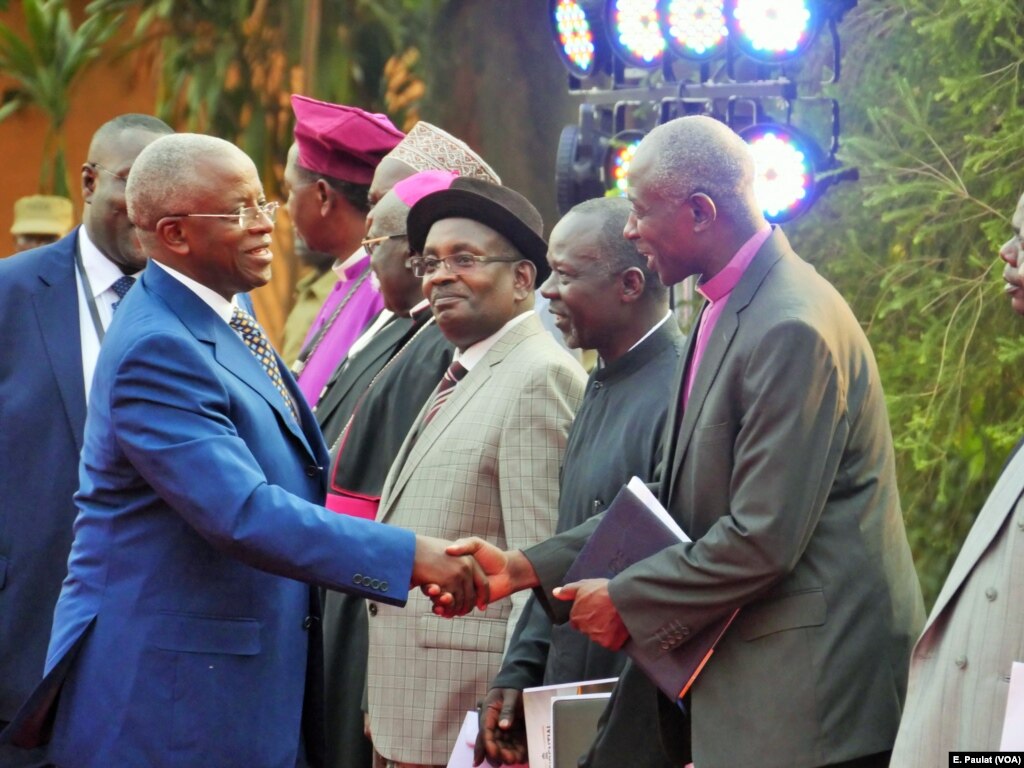
President Yoweri Museveni arrives at the debate hall in Kampala, Feb. 16, 2016, greeted by the Inter-Religious Council of Uganda.
Excitement was high as the debate got under way.
Crispy Kaheru, a coordinator for the Citizens Coalition for Electoral Democracy Uganda (CCEDU) attended the debates and said it showed an important shift in how citizens were encouraging political dialogue in Uganda.
“Uganda is one of those countries where the culture of debate is not deeply entrenched. And seeing us making baby steps in that direction is very much encouraging. And beyond a debate of this nature, I think it lays a foundation for dialogue processes to happen post the election, which is important for this country,” said Kaheru.
Presidential aspirant and former Prime Minister Amama Mbabazi arrives at the debate in Kampala, Feb. 13, 2016, greeted by the Inter-Religious Council of Uganda.
This was a sentiment shared by many, including Jermaine Eguesa, who said the organization of the event and questions posed gave him a feeling of empowerment.
“I must say it makes sense discussing foreign policy with an incumbent who has been largely in charge for the foreign policy. It made a lot of sense for me....On the overall I think it's a telling statement for people who do not believe Africa can actually practice democracy. I have been to foreign countries I know how some stereotypes are about African politics. But I think it's a telling statement. There were no fist-fights there was no name calling, it was very civil it's been very decent...Everybody has put their best foot forward,” said Eguesa.
In a press conference before the debates in Kampala, Feb. 13, 2016,Uganda's leading opposition presidential candidate Kizza Besigye of the Forum for Democratic Change (FDC) party assures reporters he can stand strong on foreign policy.
Supporters of President Museveni, such as Susan Ojyra, said she was glad Museveni could attend the debates this time, and that she preferred his straightforward style to answering questions.
“The other time when he was so busy they started speculating that he was fearing the debate. Why should he fear debate?...we feel honored because we are sure of his answers. According to the last debate actually some candidates were failing to answer straight questions, some were dodging questions,” she said.
Although many citizens have already picked their preferred candidate, some say the debates helped them choose who to vote for. Voting in Uganda is scheduled to take place this Thursday.
http://www.voanews.com/content/uganda-reacts-to-presidential-debate/3190424.html
http://samotalis.blogspot.com/

21 May, 2015

Strong Business Aircraft Growth Ahead In Africa


http://www.africabusinessforum.com/2015/05/20/strong-business-aircraft-growth-ahead-in-africa/


“Without data, you have nothing. There has been a distinct lack of data about Africa.” – Tarek Ragheb, AfBAA founding chairman


The African Business Aircraft Association (Booth A065) has released its first data-driven report that describes the state of business aviation in Africa and what association members believe needs to be accomplished to foster future growth.

The report is the product of research compiled by Jetnet (Booth Y077), the Utica, New York, aircraft market intelligence firm, including an online survey in which 84 respondents participated.

Survey respondents said their the top five priorities for business aviation in Africa are (1) training and skills development, (2) enhanced safety and security, (3) infrastructure improvements, (4) reduced taxes and fees and (5) improved airspace/airport access, according to Jetnet iQ market research.

“Without data, you have nothing. There has been a distinct lack of data about Africa. Jetnet, though, has been a believer in AfBAA from Day 1,” says Tarek Ragheb, AfBAA founding chairman. “We’re off to a great start and it [the data base] is going to get better every year.”

Two groups participated in the survey. Business aircraft owners and operators, including aircraft management and charter firms, make up the first group. FBOs, MROs, flight planning and flight services, brokers, financing companies, insurance firms, government agencies and aviation trade associations are in the second group. Four-fifths of those respondents are based in Africa. The other stakeholders have aviation business interests in Africa.

There are close to 450 turbofan business aircraft and nearly 800 turboprops based in Africa. “We looked at operators’ origins and destinations. We found that 72% of operations are inside Africa, 18% are between Africa and the Middle East and 6% are between Africa and Europe.” The average age of the African business aircraft fleet is 19.5 years, the oldest of any region monitored by Jetnet.

However, GDP grew 5.1% per year in Africa from 2004 to 2013, according to Jetnet. That’s the largest rate of growth of any region in the world. And GDP is forecast to grow at the same 5.1% rate during the next decade.

“There are a lot of bright spots in the African economy. South Africa is booming, there are rich mineral deposits in DRC [Democratic Republic of the Congo] and southwest nations, Nigeria, Zaire and Tanzania have hydrocarbons, Rwanda is developing its human potential.”

While Africa currently has a relatively small number of high net worth individuals, Jetnet research indicates that virtually the same percentage use business aircraft as in the U.S. and North America. This and forecasted economic growth bode well for the future growth of the business aircraft fleet.

Ragheb said he got the idea to start an African business aircraft association three years ago while flying over South Africa aboard a G550. “There was no organization that focused on business aviation there. We found that operators were excited to participate. We’ve grown from nothing to 93 members in three years.”

His personal goals for AfBAA are to foster development of the continent’s business aviation infrastructure, including FBOs and MROs, especially encouraging local airport authorities to make room for GA facilities; to improve pilot, technician and line service training; to expand business aircraft financing availability and to advocate for business aviation in Africa. He believes that business aviation growth in the region will be “a barometer of economic growth.”

Regarding fleet upgrades, Ragheb believes that Pilatus PC-24, Embraer Legacy 500, used Gulfstream V and new Gulfstream 650 aircraft will sell well in Africa.

He may be biased toward Gulfstream models, though, as he was with the Savannah, Georgia, firm from 1995 until 2012, when he retired as senior VP international sales. He was initially hired by Teddy Forstmann when Forstmann-Little owned Gulfstream. Forstmann lured him away from Martin-Marrietta with the promise of a moderate salary, but generous stock options. When Forstmann-Little sold Gulfstream to General Dynamics, Ragheb’s stock options were worth millions.

But Ragheb doesn’t just want to be remembered as a successful Gulfstream sales person. Now he intends to give back to the business aircraft community by investing his time and a considerable amount of his own fortune into AfBAA


http://samotalis.blogspot.com/

01 May, 2015

Workers’ Day: Wamakko Promises Quality Legislations To Boost Good Governance—


Workers’ Day: Wamakko Promises Quality Legislations To Boost Good Governance—

Gov. Aliyu Wamakko of Sokoto State on Friday promised to ensure that the 8th National Assembly will enact quality laws to enhance good governance and living standard of Nigerians.

The News Agency of Nigeria ( NAN) reports that Wamakko, who is also the Senator-elect to represent the Sokoto Central Senatorial District, made the pledge at the celebration of the 2015 Workers’ Day in Sokoto.

” We will make sure that laws are made to enhance good governance and the living standard of the generality of Nigerians.

” We will take the entire country as our entire constituency and we shall focus on ensuring probity and accountability in all government activities.

” We will also ensure that issues of welfare of Nigerian workers and all the citizens are effectively addressed.

” We will also work to ensure a harmonious relationship between the executive and the legislative arms of government for the betterment of Nigerians,” he said.

Wamakko also maintained that his outgoing APC-led administration in the state had tried its possible best to meet the yearnings and aspirations of the workers, as well as the entire people of the state.
The governor commended the workers and the people of the state for their maximum support to his administration.

Earlier, the state chairman of the Nigeria Labour Congress, Mr Aminu Umar, had lauded the state government for according top priority to issues of welfare of workers and citizens.
Umar also promised to sustain the tempo of excellent relations between the union and the state government with a view to providing more efficient services to the people of the state. (NAN)

http://leadership.ng/news/430029/workers-day-wamakko-promises-quality-legislations-to-boost-good-governance

http://samotalis.blogspot.com/

08 April, 2015

Politicians behind attack, says Ahmednasir Abdullahi


Ahmednasir Abdullahi. FILE PHOTO | BILLY MUTAI | NATION MEDIA GROUP
In Summary

In an interview with the Nation on Tuesday, the lawyer stood his ground.
Mr Abdullahi maintained that the attack was the work of criminal networks residing in the county and known to the politicians.ADVERTISEMENT

By NATION REPORTER


A city lawyer has stirred controversy on social media by linking local politicians to the terror attack on Garissa University College.


Not one to shy away from controversy, Mr Ahmednasir Abdullahi posted a series of tweets on his account claiming that the attack in which 148 people were killed was carried out by local militia and not Somalia’s Al-Shabaab terror group.


“The attack in Garissa is obviously the work of Kenyan Somalis. Let us not blame Somalia’s Al-Shabaab. This is local,” he tweeted.


“Let us be truthful to ourselves. Kenyan Somalis and their leaders must stop the senseless killings in northern Kenya. Full stop,” he said in another tweet.


And in yet another tweet, Mr Abdullahi wrote: “Evidence emerged that an employee of Garissa univ (sic) related to the mastermind of the attack (Mohamed) Kuno helped the attackers in surveying (the area) for a week.”


In an interview with the Nation on Tuesday, the lawyer stood his ground and asked politicians from the county to take responsibility for the attack.


Mr Abdullahi maintained that the attack was the work of criminal networks operating in the county and known to the politicians.


“My view is that what we saw in Garissa was a surgical strike requiring a lot of precision. Such a strike requires a lot of mapping of the target, stock piling of weapons and a clear knowledge of the university. My take is that this was a local enterprise, even the mastermind was a local,” said Mr Abdullahi.


The lawyer spoke a day after local politicians, led by National Assembly Majority Leader Aden Duale, promised to help identify the financiers of terror activities in the country.


The leaders, including Garissa Governor Nathif Jama, also demanded that the Dadaab refugee camp be closed.

http://samotalis.blogspot.com/

29 December, 2014

Ebola case confirmed in Glasgow hospital


The woman is being treated in isolation at Gartnavel Hospital in Glasgow
Continue reading the main story

Ebola outbreak
One month on
Into Ebola heartland
How disease spread
The basics

A healthcare worker who has just returned from West Africa has been diagnosed with Ebola and is being treated in hospital in Glasgow.

The woman, who arrived from Sierra Leone on Sunday night, is in isolation at Glasgow's Gartnavel Hospital.

All possible contacts with the case are being investigated, including on flights to Scotland via Heathrow.

The woman will be transferred to specialist high level isolation in London as soon as possible.

At a news conference in Glasgow, First Minister Nicola Sturgeon stressed that the risk to the general public was very low.

She added that the patient was thought to have had contact with only one other person since arriving in the city, but that all passengers on the flights the woman took will be traced.

Continue reading the main story

Glasgow Ebola case
Patient flight details - 28 December


Flight AT596 from Freetown, Sierra Leone, to Casablanca


Flight AT0800 from Casablanca to London Heathrow


Flight BA1478 from London Heathrow to Glasgow, arriving 23:30


Ms Sturgeon said: "Apart from other passengers on the flights and obviously the hospital staff since this patient's admittance to hospital, she, the patient is thought to have had contact with only one other person in Scotland since returning to Scotland last night and that person will also be contacted and given appropriate reassurance."

Alisdair MacConachie, of NHS Greater Glasgow and Clyde, said: "She's being managed in an isolation facility by staff who are comfortable managing patients in such a situation. She herself is quite stable and is not showing any great clinical concern at the minute."
Jump media player
Media player help

Out of media player. Press enter to return or tab to continue.

Nicola Sturgeon: Ebola risk 'extremely low'

NHS Scotland said infectious diseases procedures had been put into effect at the Brownlee Unit for Infectious Diseases at Gartnavel.

Ebola is transmitted by direct contact with the bodily fluids - such as blood, vomit or faeces - of an infected person.

The patient returned to Scotland from Sierra Leone late on Sunday via Casablanca and London Heathrow, arriving into Glasgow Airport on a British Airways flight at about 23:30.

While public health experts have emphasised that the risks are negligible, a telephone helpline has been set up for anyone who was on the BA 1478 Heathrow to Glasgow flight. The number is: 08000 858531

The woman had been admitted to hospital early on Monday morning after feeling unwell and was placed into isolation at 07.50.

Ebola case confirmed
What is Ebola?
What you need to know
Why Ebola is dangerousNext


http://samotalis.blogspot.com/

08 October, 2014

Kenyatta appears at ICC in Hague for landmark hearing

Kenyatta appears at ICC in Hague for landmark hearing

A large crowd was waiting for Uhuru Kenyatta outside the court, as Anna Holligan reports

Related Stories

Kenyan President Uhuru Kenyatta has appeared before the International Criminal Court (ICC) where he faces charges of crimes against humanity.
He is the first serving head of state to come before the court in The Hague.
He was called to appear at the ICC "status conference" when the prosecution said evidence needed to go ahead with a trial was being withheld.
The charges - which Mr Kenyatta denies - concern his alleged role in violence following the 2007 elections.
More than 1,000 people died in the aftermath of the poll.
Mr Kenyatta says the charges against him are politically motivated and insists that the case should be thrown out.
The prosecution accuses the Kenyan government of obstructing the investigation.
Packed gallery
The BBC's Anna Holligan in The Hague says there were chaotic scenes as Mr Kenyatta arrived at the ICC, where a large crowd was waiting.
The ICC wants him to explain allegations that evidence against him had been withheld by the Kenyan government - a claim rejected by Kenyan Attorney-General Githu Muigai, who appeared before the court on Tuesday.
Grey line
At the scene: Anna Holligan, BBC News, The Hague
Uhuru Kenyatta talks to lawyers at ICC. 8 Oct 2014Uhuru Kenyatta appeared relaxed as the hearing got under way
Uhuru Kenyatta cuts a composed figure in court. He sits back, occasionally glancing at his "first family"' on the front row of the public gallery. He is wearing a patriotic bracelet in the Kenyan colours. Never has there been a more glamorous audience in attendance. Pink and yellow headscarves and gold earrings punctuate the mostly grey suited public space, bringing some colour to the dark period of Kenyan history that is the subject of this hearing.
The president temporarily relinquished power to come to The Hague. Nevertheless, his convoy received a presidential welcome. Flag-waving crowds surged as his police-escorted car pulled up. International TV crews jostled to get him in their frame.
This trial is testing the limits of international justice. The prosecution says Kenya is not co-operating by handing over evidence. Kenya says that if they do not have the evidence, the charges must be thrown out. The ICC was partly designed to demonstrate that even the most powerful leaders cannot be above the law. Regardless of whether Uhuru Kenyatta is guilty or innocent, one thing he has proved is that it is extremely challenging to prosecute a president.
Grey line
Scores of Mr Kenyatta's supporters packed the public gallery as the hearing got under way.
Defence lawyer Steven Kay said Mr Kenyatta would not be making a statement. He said the government had co-operated with the prosecution requests where it was possible to do so.
The hearing was later adjourned.
The prosecution has accused the Kenyan government of failing to hand over potentially crucial pieces of evidence, as Anna Holligan reports
ICC chief prosecutor Fatou Bensouda, who is from The Gambia, said there was still a significant "body of evidence" against Mr Kenyatta.
The prosecution, which wants an indefinite adjournment, told the court it had phone data and nine witnesses who were willing to testify how Mr Kenyatta had funding links with the Mungiki sect which took part in the violence.
Fergal Gaynor, a lawyer for the victims, said they were entitled to know why witnesses for the prosecution had withdrawn from the case.
In September, the court postponed the trial after prosecutors said the Kenyan government had failed to deliver key documents.
Personal capacity
Deputy President William Ruto is acting president while Mr Kenyatta is at The Hague.
Supporters of President Kenyatta outside the court. 8 Oct 2014Supporters of President Kenyatta called on the ICC to drop the case
On Monday, the president again stressed his innocence, saying his conscience was clear.
In a speech to the Kenyan parliament, Mr Kenyatta said that he was going to The Hague in a personal capacity - not as president of the country - so as not to compromise the sovereignty of Kenyans.
No special arrangements have been made at the ICC. The main spokesperson for the court said that Mr Kenyatta would not be treated differently from any other accused person.
Earlier, former ICC chief prosecutor Luis Moreno Ocampo conceded that the trial "was not working well" but welcomed Mr Kenyatta's appearance as "showing African commitment to change".
Mr Kenyatta was elected in 2013, despite facing charges. Analysts said he turned the prosecution to his advantage, portraying it as foreign intervention in Kenya's domestic affairs.
Mr Kenyatta has accused the court of being biased against African leaders.
In 2009 the ICC also issued a warrant for Sudanese President Omar al-Bashir over alleged war crimes in Darfur, but he has not yet been arrested.
Members of the Luo tribe in Kenya in post-election violence in 2008The violence after the 2007 poll left 1,200 people dead and displaced tens of thousands more
Presiding judge Kuniko Ozaki from Japan. 8 Oct 2014Presiding Judge Kuniko Ozaki from Japan opened Wednesday's hearing at the IC
William Ruto waves to the public after being handed over the presidential powers by President Uhuru Kenyatta on Monday (6 October 2014)William Ruto (waving) has been appointed acting president - he also faces charges at The Hague
Mr Kenyatta faces five charges relating to the ethnic massacres - the worst violence in Kenya since independence in 1963. Tens of thousands of people were displaced and Kenya's reputation for stability was tarnished.
Mr Kenyatta was a close ally of President Mwai Kibaki, who was declared the winner of the 2007 election. Mr Kibaki's rival, Raila Odinga, claimed the poll was marred by fraud.
The dispute took on an ethnic dimension, pitting members of the Kikuyu ethnic group of Mr Kenyatta and Mr Kibaki against other communities. Mr Kenyatta is accused of organising an ethnic Kikuyu gang, the Mungiki sect, to attack rival groups.
Deputy President Ruto also faces charges at The Hague, but he was on Mr Odinga's side during the violence. He also denies the charges.

http://samotalis.blogspot.com/

Ethiopia – Doing it the Japanese way

Ethiopia – Doing it the Japanese way

The Japanese workplace philosophy of Kaizen is sweeping all before it in factories and workshops in Ethiopia. The philosophy, developed by Japan after World War II to make the most of meagre resources through efficiency, seems to be a perfect fit for Ethiopia’s industrial needs. James Jeffrey made the rounds of businesses in Addis Ababa to find out how the idea works and with what results.
Inside a dimly lit shed, a projector displayed a PowerPoint presentation onto a hastily rigged sheet of wood. Although the text was in Amharic, the main language of Ethiopia, the ideas behind the bullet points are summed up by one Japanese word: Kaizen. A small group of Ethiopian furniture makers sat and listened intently to the instructor from the Ethiopian Kaizen Institute (EKI), while in the back row a woman scribbled into a notepad.
Kaizen is a Japanese management philosophy that allows companies to continuously improve their productivity and product quality with available resources and without depending on new investment – and it is taking root in Ethiopian business culture.
The Addis Ababa-based EKI was established through a partnership between the Ethiopian government and the Japan International Cooperation Agency (JICA), a Japanese governmental agency focused on development through technical cooperation.
JICA has already introduced Kaizen to other African countries although its Japanese staff think Ethiopia can become a Kaizen hub due to its business situation being such a good fit for Kaizen ideas and methodologies. Ethiopian end users seem to be reacting positively to this Japanese business ethic that can trace its lineage back to the birth of Zen Buddhism.
“The workers are involved and can see the changes,” said Dawit Birasa, manager of plans and programmes at Peacock Shoe Factory, an Ethiopian company based in an Addis Ababa industrial zone and which last year embraced Kaizen. “It’s understandable and not complicated, which is a big advantage.”
Between 15th January 2013 and 22nd May 2013, a team of Kaizen consultants from EKI visited the factory 17 times to instruct workers and management on Kaizen and how it can be used to identify bottlenecks in manufacturing processes, develop action plans, provide solutions and evaluate results to instigate further improvements. By the end of May, production of quality men’s and ladies shoes had increased from 500 pairs every eight hours to 800 pairs, many of which are exported across much of Europe.
JICA’s Kaizen programme started in November 2011 and will run until October 2014. In addition to production improvements, reductions to costs and elimination of waste have amounted to savings totalling tens of thousands of dollars for companies involved in JICA’s programme.
Less tangible benefits include attitudes changed for the better, more mutually beneficial relationships between workers and managers, and improved team work and motivation levels starting at the lowest level of workers and continuing upward through a company’s hierarchies. Kaizen emphasises a bottom-up approach.
By the end of its programme, JICA aims to have trained 65 EKI consultants working with 65 large and medium enterprises, and 190 Kaizen train-the-trainers working with 190 micro and small enterprises.
Even if those figures are not met, the establishment of the EKI means that numbers trained by the institute in the future will far exceed JICA’s contribution. Those at JICA wouldn’t have it any other way. “By starting their own training initiatives there will be many more beneficiaries,” said Yuko Ikeda, JICA’s project formulation advisor for private sector development. JICA specialises in capacity building and enabling organisations achieve self-sufficiency – hence JICA programmes always have an end date.
The PowerPoint presentation to the workers at Mesker Metal & Wood PLC was only the third visit to the company by an EKI team. The ramshackle layout inside the compound indicated there was much potential for the sort of business streamlining promulgated by Kaizen. Before the presentation started, the two workers I spoke to didn’t yet seem to understand much about Kaizen, although one of them said he hoped to see workspace improvements.
“The main problem is in the workshop where materials are not accessible and it’s hard to get the right measurements,” said Selamu Bereka, clad in dusty blue overalls. “When we finish, the [cupboards] are not as good as they could be.”

http://samotalis.blogspot.com/

28 August, 2014

Blood woes in Burundi


Blood woes in Burundi

BUJUMBURA, 27 August 2014 (IRIN) - Budget cuts and bureaucracy have been blamed for blood shortages which have claimed several lives in Burundi and led to calls for an overhaul of the transfusion system.


"One woman died during a Caesarean operation in Bujumbura, another died in Gitega, in the centre of the country, while a third patient died in Ngozi in the north of Burundi," said Moise Ntiburuburyo, who heads the Association for the Defence of Patient Rights.


A shortage of bags has left many hospitals across the country with severe shortages of blood in recent weeks, leading, according to Ntiburuburyo, to scheduled operations being delayed.


The head of the National Blood Transfusion Centre (CNTS), Gilbert Nduwayo, told IRIN the Centre had received some 1,500 blood bags since the weekend, allowing his teams to go out and collect blood in different parts of the country.


Although the problem was not yet over, the situation was under control, he said.


Gilbert attributed the shortage to insufficient funding and to the procedures he was required to follow to procure blood bags which can take up to two months to complete.


CNTS, the only organization authorized to collect blood in Burundi, needs an annual 1.2 billion francs (US$775,000) to work properly but only gets 575 million ($370,000), he said.


Mélance Hakizimana, the head of SYNAPA, a medical workers union, described the shortage as a "scandal" and called for "urgent investigations" into the crisis.


CNTS has not been working normally for the past five months, she said, calling for its budget to be beefed up.


"How can it be that the CNTS complains of having no vehicles for blood collection while some senior [health] ministry officials have just procured new vehicles and continue to collect mileage allowances of up to 500,000 francs ($322) when the CNTS has no blood bags which cost 2,500 francs ($1.6)?" she said.


At the start of 2014, the CNTS budget was cut by 50 million francs, badly affecting operations even after this amount was restored mid-year, Nduwayo explained.


The Centre needs to collect some 16,000 bags of blood to meet needs for the rest of the year, he said.


Ntiburuburyo, the patients' rights advocate, said patients would be better served if the capacity of blood banks were increased and the process of taking blood automated.


With such a system blood can be collected from 10 people in a couple of minutes and then very quickly tested, compared to the current method where it takes 15 minutes to draw blood from a single donor, he explained.


dn/am/cb[END]

14 July, 2014

Eritrea: The only country able to withstand aggressive US adventurism

isyas_afwerki2014

Eritrea: The only country able to withstand aggressive US adventurism

Asmara (HAN) July 12, 2014. Expert Analysis, Your Power & Regional Influence Magazine, opinion page by Amanuel Biedemariam. President Baraka Hussein Obama extended an invitation to all African leaders except Eritrea which are not in good standing with the United States. Why Eritrea?
In Washington, the White House announced that the First American Black leader will host the first United States and Africa Leaders Summit in Washington, on August 5 and 6, 2014. The U.S. President Baraka Hussein Obama looks forward to welcoming leaders from across the rising African continent to the Nation’s Capital to further strengthen ties with one of the world’s most dynamic and fastest-growing regions.
More specifically Eritrea leader Isaias Afwerki were not invited, but, President Baraka Hussein Obama issued invitations  to the heads of state from Angola, Algeria, Benin, Botswana, Burkina Faso, Burundi, Cameroon, Cabo Verde, Chad, Comoros, Republic of the Congo (Brazzaville), Democratic Republic of the Congo (Kinshasa), Cote d’Ivoire, Djibouti, Equatorial Guinea, Ethiopia, Gabon, the Gambia, Ghana, Guinea, Kenya, Lesotho, Liberia, Libya, Malawi, Mali, Mauritania, Mauritius, Morocco, Mozambique, Namibia, Niger, Nigeria, Rwanda, Sao Tome and Principe, Senegal, Seychelles, Sierra Leone, Somalia, South Africa, South Sudan, Swaziland, Tanzania, Togo, Tunisia, Uganda, and Zambia.

The Reason is based the short Opinion Written by Amanuel Biedemariam: A young Eritrean that was born in the US once said, “When I hear people call Eritrea a new nation, it startles me because I grew knowing Eritrea to be a nation.” Most Eritrean children that grew up in the US before independence have encountered people that told them Eritrea does not exist on the map. Their answers were always that Eritrea existed in their heart and they knew that she will be free.
The subtle way the West pulled Eritrea’s annexation left Eritreans empty handed without a country, under primitive tyranny of Ethiopia’s pseudo monarchy. In a flash, they defeated the surrendering Italian army led by British troops into Asmara Palace and not long-after, British soldiers and the US escorted Emperor Haile Selassie into Asmara with his wife and handed him a nation without having to lift a finger. Great Britain’s recently declassified World War II videos show this transaction clearly.
Eritreans who dreamt of independent Eritrea were forced to flee, killed or imprisoned. That in effect marked the start of the liberation struggle. Eritrea ceased to exist as a nation then. However, Eritrea was alive in the hearts and minds of Eritreans. Heart is the foundation of the Eritrean psyche, the place where Eritrea lives no matter where and it is where it all starts and still continues to date.
With nothing but determination, Eritreans embarked on a long and arduous journey to freedom. Without resources and military expertise Eritreans flocked to the field to fight against US funded Ethiopian troops. In no time, Eritrea managed to establish a full-fledged army that included tanks  captured from enemy soldiers. Moreover, while the fighting was taking place, Eritreans were focused on reestablishing Eritrea after victory hence embarked on a nation building campaign.
The people of Eritrea accomplished the unthinkable, unimaginable and seemingly impossible fit. With principled approach to struggle, clear-aim stemming from the iron-willed Eritrean heart, by empowering Eritreans with education, by organizing, arming-them with everything they need to succeed as a unit and by Self Reliance Eritrea won.
The manner in which Eritrea came to life is a history that the Soviet Union, United States and their allies shun to talk or write because it highlights the defeat of their agendas. That also means given a choice these enemies would not have liked to see independent Eritrea.
In 1991, the US tried to block Eritrea’s independence but failed because Eritrea knew what to do and where to go. Eritrea took-out the system in Ethiopia and propelled the current regime, in a sense conducted a regime change; a first seamless transition conducted by an African nation, and ensured the signature that sealed independence. No African nation would admit that the current regime in Ethiopia is a byproduct of the struggle propelled to power by Eritrea.
Eritrea’s independence was significant historical event that reshaped the Horn of Africa’s geostrategic map. It came at a time when the Soviet Union fell and the US became the sole-superpower. The breakup of the USSR accorded the US opportunity to control the region. Uganda, Rwanda, Kenya, Tanzania, Burundi, Kenya and Ethiopia became US client-states with Ethiopia as a hub. Eritrea was also a part of that equation.
After the Cold War, the US controlled the region by proxies. At the time the Clinton administration lauded these “new generation African leaders” including His Excellency President Isaias Afwerki as the hope for the future. That was short-lived because while the others kowtowed to US interests Eritrea forged independent path to the dismay of US marking new Era of US Eritrea relations. Eritrea was the only nation thus a spoiler of US hegemony. Cooperation, mutual interests-based bilateral relations with Eritrea would set a bad precedent; hence, a regime change policy was initiated against Eritrea.
The machinations to ensnare Eritrea under the pretext of border-war were initiated leading to countless death, loss of limbs and population displacement. Had they succeeded, Eritrea would have been soaked-in-blood for generations. Eritrea managed to foil all their sinister attempts.
However, these machinations continued. The UN was manipulated to pass punitive measures that denied Eritrea her inalienable rights for self-defense with illegally manipulated and fabricated sanctions under the guise of “African nation’s initiative” when the actual violators were Ethiopia and the US that brazenly and violently invaded Somalia, a sovereign nation.
The levels of covert and overt activities on Eritrea remain relentless. All the defamatory campaigns and destabilizing activities against Eritrea trace their roots to Ethiopia and US. The US continues the assault with the youth as their key target. Recent State Department regarding Eritrean refugees from the Afar region indicate continuation of a hostile policy geared at encouraging youth flight. The regime change policy is still on play. US authorities are still trying to divide the people of Eritrea from the government.
In 2009, on Christmas Eve, when Ambassador Susan Rice boasted the sanction she placed upon the people of Eritrea, she said the US supports the people of Eritrea. In a similar Fashion, when Secretary John Kerry extended his warped independence letter, in May of 2014, he also said the US stands with the people of Eritrea.
Although it is an open secret, why deny congratulations to the government that brought independence of Eritrea? That is duplicity and sign of continuation of the policy. Nothing in the history of the US demonstrates US support for the people of Eritrea. The fact that Secretary Kerry deliberately misrepresented Boston Marathon-winner Meb Kiflezgi’s identity by calling him Kenyan when he knows that Meb is Eritrean-American is evidence that they do not want to acknowledge Eritrea.
Cold War Part II
During the Cold War, due to the global-geopolitical juxtaposition, Eritrea was caught on a seesaw that affected her negatively. That ended at the time when Eritrea won independence and the fall of USSR. Over the last two decades, the world witnessed the destruction of Iraq, Libya, Syria and unforeseen changes in many places such as Egypt. However, after 23 years of US adventurism, the world is experiencing yet another transition that will influence nations. The situation in Ukraine seems to be the game-changer having monumental impact on world politics.
When the US pressured Russia with swift actions including sanctions for Crimea, Russia and China lashed back in ways that changed the world. With a stroke of pen, China and Russia brought down-to-earth the notion of US as sole-super-power. By signing huge energy trade agreement, they invalidated the sanction threat and placed the EU-nations that supported the sanctions on a precarious position. Countries such as Germany were forced to retract, in a sense created a wedge between EU and the US.
The agreement is diminishing the role of the petro-dollar and re-establishing a new economic order that could counter US’s. The bilateral agreements will have implications on relations between nations, on the UN working-pecking-order, on the global economy, on previously US
engineered-UN and other sanctions, and on global politics. A shift on global-alliances independent from US is in place. Hence, for the first time in years, it appears the world is poised for a multi-polar world-order independent from US control.
The most import impact however is on the US dollar. When countries start to trade with other currencies, the value of the dollar falls precipitously and it damages the reserve currency that enabled the US to print money with impunity. Countries that depended on US finances to sustain their economies will crush. This includes countries like Ethiopia that receive billions of US dollars as food and security aid. Absent of new funding sources these countries will crush.
These new geopolitical developments will influence the political dynamics of various regions in Africa. The penetration of China by using/dumping the dollar to gain influence, Russia’s assertive-stances at the UN Security council is dissolving previously US dominated roles, thus diminishing US influences profoundly. For example China is building rail infrastructure that connects Kenya, to South Sudan, Uganda, and Rwanda.
These global developments will lead to changes of outdated US Africa policy. However, these changes will not come willfully. It will come due to US’s inability to manage situations that are spiraling out of control, changing global realities, and lack of funding. At the end, cost- benefit
analysis will force US policy changes.
For example Ethiopia will, in short time, be too expensive to manage. To divide-and-rule the TPLF junta divided Ethiopia along ethnic and religious lines. Many Ethiopians have been crying foul due to fears that religious clashes could lead to genocide in Oromia and other places. Dr. Gregory Stanton of Genocide Watch has been warning about genocide in Ethiopia. Moreover, Ethiopia’s interventions in various parts of the region will undoubtedly have repercussions.
The effect on Eritrea
The difference between 1991 and now Eritrea was stripped-bare then. Today, the reality in Eritrea is different. The mere fact that food security is attained is a game changer. Eritrea is in much better place and able to stand independently. Eritrea is the only country able to withstand
aggressive US adventurism. It is ironic that Eritrea, a country that ascended at the fall USSR is managing to witness yet another cold war like event on the offing. Except this time the table appears to be turning with US super-power status on the decline while China and Russia rise.
Issias Aferworki is supposed to be a dictator, a tyrant, a leader “who kills his own people” according to just about every western media and human rights outfit there is, yet there they were, over 5,000 very proud and happy Eritreans giving him a hero’s welcome, standing ovations inside and wildly cheering throngs outside greeting his arrival and especially when he joined the crowd outside before his departure. His Last trip in new York.
Even when nations knew Eritrea is standing truthfully by the law, no one stood for justice on the side of Eritrea for fear of retaliation by US. Regardless, the people of Eritrea knew, as President Isaias Afewerki said, “That this adventurism will not last.” The people of Eritrea stood together and fought knowing that the fight is for the very-existence of Eritrea and paid the price demonstrating that Eritrea can stand without having to depend on any power. As a result, today, countries are looking for allies and Eritrea is a perfect choice. Eritrea’s ability to defend herself and the neutral stances are bearing fruit.
Eritrea was able to withstand the wrath because of the UNITY of the people, and successful national-service program. Every Eritrean, no matter where they live or who they are, has to participate. As a result Eritrea has the most disciplined military population on the world. The people of Eritrea know how to respect the gun and live with it while protecting the nation.
The mature-nature and the discipline makes Eritrea the most peaceful nation in Africa.
Eritrea’s greatest resources are the people not the rich natural resources the nation is endowed with. It is also national service and the unity of the people. And not surprisingly the enemies’ main targets are Eritrea’s human resources. The US and Ethiopia are doing everything to deny Eritrea her youth; attack the national service program and create divisions amongst the people. Their main aim is to find or create a crack.
Conclusion
Eritrea stood strong by the incorruptible leadership that brought Eritrea the time and space necessary to roll-with-the-punches. They secured the room necessary that allowed Eritreans to see global developments and learned from it with patience. Eritrea focused on the bigger picture
avoiding traps of temporary PR gains. They showed sacrifice and selflessness that the people can identify. They showed resilience under pressure and told the world we will do it our way, the Eritrean way. Most importantly Eritrea is here by the united-will and strength of the people.
It is time to strengthen our unity and stand for what the martyrs gave their lives. Above all, be smart; lift each-other and our communities no matter where we are. That is what time it is.
Wetru Awet N-Hafash
Zel-Alemawi Zikri N-Sema-e-tatna
- See more at: http://www.geeskaafrika.com/eritrea-the-only-country-able-to-withstand-aggressive-us-adventurism/4368/#sthash.kxysMvR5.dpuf

http://samotalis.blogspot.com/