| |||||||||||||||||||||||||||||||||||||||||||||||
31 January, 2009


Jewish backlash against Vatican gathers pace
"The dialogue that we began in 2000 following the visit of former Pope John Paul II cannot continue as if nothing has happened after such a decision, announced nearly on the day that the international community commemorates the Holocaust," he said.
Pope Benedict XVI has found himself in hot water with Muslims, native Indians, Poles, gays and even scientists during nearly four years as pontiff, but the current row comes in the run-up to a first visit to Jerusalem planned for May, but which might not now take place.
The pope's decision to lift the excommunication of English bishop Richard Williamson has infuriated the Jewish community since Swedish television aired an interview in which he dismissed as "lies" historians' conclusions that some six million Jews were killed in the Holocaust.
Williamson said only between 200,000 and 300,000 Jews died before and during World War II, and none in gas chambers.
Wiener said he had written to the Vatican demanding that Williamson apologise, adding that the pope's remarks on Wednesday, in which he expressed "solidarity" with Jews and condemned denial of the Holocaust, were "important... but not enough."
He did not exclude participating in the March meeting in Rome if the Vatican's response was "satisfying."
Cardinal Tarcisio Bertone, the Vatican's secretary of state, said Wednesday that the 81-year-old German pontiff had been "troubled" by Williamson's comments.
However, the head of Germany's Jewish community said she too was pulling out of dialogue with the Roman Catholic church over the issue.
"Under such conditions there will certainly be no conversation between the Church and me at the moment -- but I stress 'at the moment'," Charlotte Knobloch told the daily Rheinische Post.
"The pope is one of the most well-educated and intelligent people that the Catholic Church has and every word he speaks, he means and is also well-researched," she stated.
The chairman of the German Bishops' Conference, Robert Zollitsch, said in a statement he was working towards damage control.
"I am trying to arrange a meeting with representatives of the Central Council of Jews in Germany," he said, adding that he would fight to maintain progress made in Catholic-Jewish dialogue in recent years.
More than 200 Swiss priests and theologians also signed an open letter saying the Williamson decision was just the latest in a series of "seriously regressive" measures.
The head of the Swiss-based "Lefebvrist" fraternity, Bernard Fellay, this week distanced the community from Williamson's comments and apologised to Benedict over the remarks, according to a Vatican statement.
But a fellow member of the Priestly Society of Saint Pius X added fuel to the fire in an interview published Thursday in Italian daily La Tribuna di Treviso.
"I know that gas chambers existed at least for disinfecting but I can't say whether they caused deaths because I haven't explored the question in depth," Floriano Abrahamowicz was quoted as saying.
The Netherlands, meanwhile, urged the pope to condemn Williamson's comments.
"Not only are these views patently false, they are also shocking and offensive to many people, especially at a time that anti-Semitic slogans are again being heard in Europe," the foreign ministry said in a statement.
Foreign Minister Maxime Verhagen has insisted that the pope explicitly denounce the statements by the bishop and that he publicly apologise "for the pain and suffering he caused".
http://samotalis.blogspot.com/
Israel faces Spanish investigation
| Israel faces Spanish investigation | ||||
A Spanish judge has agreed to hear a complaint against seven senior Israeli military figures, accused of crimes against humanity over a bombing in Gaza in 2002, which killed 15 Palestinians. Fernando Andreu, a Madrid-based judge, has set up two commissions to address the complaint lodged by the Palestinian Centre for Human Rights, a judicial source said on Thursday. The Spanish case is in line with the country's stance that the principle of universal jurisdiction in alleged cases of crimes against humanity, genocide, and terrorism should be applied. 'Excessive' force The case will examine an Israeli air raid on July 22, 2002, on Gaza City which killed 14 civilians and a senior member of Hamas. Andreu said the attack "showed signs of constituting a crime against humanity," the judicial source said.
Ehud Barak, Israel's defence minister, said in a statement that he "intends to fight vigorously against the accusations in Spain and do everything possible to get the investigation dismissed". Barak said that he "vehemently rejects the delirious announcement by a Spanish judge", adding that "anyone who considers the elimination of a terrorist a crime against humanity lives in an upside-down world". "All those in charge of defence have acted and continue to act in a proper manner in the name of the state of Israel, in the name of their duty to ensure the security of the citizens of Israel," the statement from Barak said. Tzipi Livni, Israel's foreign minister told Miguel Angel Moratinos, her Spanish counterpart in a telephone conversation that "Israel is treating [the decision] with utmost gravity". Livni said that the judge "decided to go ahead with the probe without being in possession of all the documents necessary to the case," a statement from the Israeli foreign ministry said. Spanish assurance Moratinos said that Spain "would do everything necessary for [the case] to have the least impact and have a satisfactory solution" but emphasised that the court should be independent. In addition to Ben-Eliezer, the complaint names General Moshe Yaalon, Israel's army chief of staff, and General Dan Halutz, then head of the Israeli air force. General Doron Almog, Giora Eiland, the national security council head, Michael Herzog, a defence ministry official, and Avi Dichter, director of the Shin Bet intelligence agency, are also subject to the case. Andreu's decision to take on the complaint comes in the wake of Israel's 22-day war on Gaza. Doctors in Gaza say that more than 1,300 Palestinians, nearly a third of them children, were killed during the recent attacks on the coastal territory. Thirteen Israelis were killed during the operation, which had the stated aim of stopping rocket fire by Palestinian fighters from Gaza into Israel. | ||||
|

http://samotalis.blogspot.com/
Erdogan hailed after Davos walkout
| Erdogan hailed after Davos walkout | |||||||||||||||
Turkey's prime minister has returned home from the World Economic Forum in Davos to a warm welcome after he stormed out of a debate over Israel's war on the Gaza Strip. More than 5,000 people, many waving Palestinian and Turkish flags, greeted Recep Tayyip Erdogan after his aeroplane touched down early on Friday. Erdogan walked out of a televised debate on Thursday with Shimon Peres, the Israeli president, after the moderator refused to allow him to rebut Peres' justification about the war. Before storming out, Erdogan told Shimon Peres, the Israeli president: "You are killing people." At least 1,300 Palestinians were killed during Israel's 22-day aerial, naval and ground assault on Gaza. Thirteen Israeli citizens died over the same period. During the heated panel discussion in the Swiss town, Peres told Erdogan that Turkey would have acted in the same manner as Israel if rockets had been falling on Istanbul.
Moderator David Ignatius, a Washington Post columnist, then told Erdogan that he had "only a minute" to respond to a lengthy monologue by Peres. Erdogan said: "I find it very sad that people applaud what you said. There have been many people killed. And I think that it is very wrong and it is not humanitarian." Ignatius twice attempted to finish the debate, saying, "We really do need to get people to dinner." Erdogan then said: "Thank you very much. Thank you very much. Thank you very much. I don't think I will come back to Davos after this." 'Understandable' Amr Moussa, the secretary-general of the Arab League and former Egyptian foreign minister, said Erdogan's action was understandable. "Mr Erdogan said what he wanted to say and then he left. That's all. He was right," he said, adding that Israel "doesn't listen". Turkey has in recent months brokered indirect talks between Israel and Syria over the Golan Heights region, which Israel captured from Syria in 1967. The exchange between Erdogan and Peres took place on the second day of the summit, where business and political leaders have been discussing trade, financial regulation and global security. Ban Ki-moon, the United Nations secretary-general, used the forum to announce the launch of an emergency appeal for $613m to help Palestinians recover from Israel's attack on Gaza. Gaza appeal The UN secretary-general said he had been deeply moved by his visit to Gaza and that he had given his word that the UN would help the Gazans in their hour of need.
Ban said it would help provide aid such as medical care and clean water and that an appeal for longer-term needs would be launched later. Asked about achieving peace in Gaza, Benjamin Netanyahu, the leader of Israel's Likud party who was attending the forum, swiftly turned his answer to Iran, which he said was in a "100-yard dash" to get nuclear weapons. While he did not specify any planned military action, Netanyahu said if Iranian rulers were "neutralised", the danger posed to Israel and others by Hamas in Gaza and Hezbollah in south Lebanon would be reduced. Meanwhile, Manouchechr Mottaki, Iran's foreign minister, who is also in Davos, said Tehran had taken note of the intention of Barack Obama, the US president, to withdraw troops from Iraq and believed he should also pull troops out of Afghanistan. Mottaki told a panel at the forum that Obama had "courage" to say which of the policies of George Bush, the former US president, he disagreed with and said his approach marked a "milestone" away from an era of "might equals right". | |||||||||||||||
|

 Focus
Focus

http://samotalis.blogspot.com/
Profile: Sheikh Sharif Sheikh Ahmed
| Profile: Sheikh Sharif Sheikh Ahmed | ||||
Sheikh Sharif Sheikh Ahmed, 44, won a majority of the votes when the Somali parliament elected a new president on January 31.He is the former leader of Somalia's ousted Islamic Courts Union, which waged a bitter war against the country's weak transitional government. In late 2006, he was forced to flee the country amid an Ethiopian invasion supporting the government.Ahmed currently chairs a group of opposition leaders called the Alliance for the Re-liberation of Somalia (ARS) and is an influential religious leader in the country. Considered a "moderate" Muslim, he was born in the Mahaday district, about 100km north of Mogadishu in 1964.After attending Islamic schools in Somalia, he went on to study in Sudan and Libya during the 1990s before becoming a geography teacher in a Mogadishu secondary school. He has said it was the kidnapping of a young student for ransom that drove him to set up an Islamic sharia court to rid the capital of banditry. He has led the Islamic Courts since July 2004. The organisation drew together more than a dozen sharia tribunals set up in the 1990s to restore a degree of law and order to the capital Mogadishu. Islamic courts rule By the summer of 2006, the Islamic courts had managed to unify Mogadishu, and under Ahmed's leadership, the Islamic Courts and the allied al-Shabab armed group gained control of most of southern Somalia.
Seeing the movement as a threat to both itself and the UN-backed transitional Somali government, Ethiopia entered its Horn of Africa neighbour in December 2006, forcing out the Islamic Courts. Ahmed surrendered to Kenyan authorities on the border in January 2007, although he was released days later. He returned to Somalia last November under UN-sponsored peace agreements with the transitional government signed in Djibouti in July and October 2008. Presidential bid Under those deals, Ethiopian forces have pulled out of the country - a situation Sheikh Ahmed has claimed credit for.Seats in the Somali parliament were also doubled to 550 in order to accommodate 200 members of Ahmed's group, as well as 75 other opposition figures.Ahmed was banking on that, and support from his numerically-strong Abgal clan of northern Mogadishu to win him the presidency. "My first priority is to bring peace to Somalia and I will serve the nation to the best of my ability," he has said of himself.Sharif Hassan Sheikh Aden, former speaker of the Somali parliament, has also backed his candidacy, saying Ahmed "is one of the most prominent figures in Somalia". "Sheikh Sharif is the best choice to overcome the current crisis," he said. Al-Shabab, Ahmed's former allies, have rejected the Djibouti peace deals, and are expected to fight against Ahmed when he takes office. | ||||
source:aljazeera |


Geography teacher new Somalia president
NAIROBI, Kenya -- Sheikh Sharif Sheikh Ahmed, once depicted as the dangerous leader of "Africa's Taliban," has emerged from Somalia's violent chaos as a moderate figure to claim the war-torn country's presidency.
The young cleric was elected by parliament during a session in Djibouti on Saturday and succeeds Abdullahi Yusuf Ahmed, who resigned from the helm of the transitional administration last month after a bitter power struggle.
When his Islamic Courts Union (ICU) took power in 2006 and imposed a strict form of Sharia in Mogadishu and other towns, Sheikh Sharif, in his forties, became the man to bring down.
Ethiopia -- the previous United States administration's strongest regional ally -- invaded Somalia later that year with a mandate to topple Sheikh Sharif's ICU and prop up the embattled transitional federal government (TFG).
He was forced into exile with much of the ICU's political leadership and, in Asmara, founded the Alliance for the Re-liberation of Somalia (ARS), an Islamist-dominated opposition umbrella group.
Meanwhile the ICU's former armed wing, the Al Qaeda-linked Shebab, waged a brutal guerrilla war against Ethiopian troops, in fighting that left thousands of civilians dead and displaced hundreds of thousands of others.
Sheikh Sharif has since joined the United Nations-sponsored reconciliation process with the TFG, setting the stage for an Ethiopian withdrawal that was completed in January this year.
"He probably never was the big bad wolf that the international community made him out to be," said Stig Jarle Hansen, a Nairobi-based researcher at the Norwegian Institute for Urban and Regional Research and an expert on Somalia.
"He made unfortunate alliances with radicals who later turned into the Shebab but I think he always represented the political center and has a reputation for integrity that few Somali leaders have," he added.
Sheikh Sharif is from the town of Jowhar and belongs to the Abgaal branch of the Hawiye clan, which is one of the country's two largest and prominent in central Somalia and Mogadishu.
He studied in Libya and Sudan and became a geography teacher.
The abduction of one of his young pupils in 2002 is believed to be what prompted him to take action against the warlords who had ruled the country for years.
Sheikh Sharif set up an Islamic court in his CC area of Mogadishu which made him a hero with the local population by re-establishing some form of justice in the war-ravaged capital.
The CC court was considered one of the most moderate of the ICU's Sharia tribunals but Sheikh Sharif definitively fell out with the international community when he called for jihad (holy war) against the Ethiopian invader.
Last November, he returned to his stronghold of Jowhar, located some 90 kilometers (55 miles) north of Mogadishu, for the first time in two years and after Ethiopian troops pulled out of the town.
He was given a hero's welcome but the reality on the ground soon restrained any plans for a swift return of military influence and his ARS-Djibouti security forces are believed to be in the hundreds, not the thousands.
Some of his commanders in the ICU have made a habit of violating his ceasefires and some of his forces have also implemented very harsh forms of Sharia justice.
With many parts of southern Somalia firmly under hardline Islamist control, observers say his ability to prove himself as a president will hinge largely on whether or not he can stabilize the country's central regions.
http://samotalis.blogspot.com/
|
African Leaders Await Outcome of Somalia Presidential Election
African Leaders Await Outcome of Somalia Presidential Election
Addis Ababa
30 January 2009
 |
| Abdullahi Yusuf (file photo) |
As the Somali parliament began its secret balloting process Friday in Djibouti, several of the 15 candidates withdrew from the race, making it look more like a contest between Prime Minister Nur Hassan Hussein and the moderate Islamist leader Sheik Sharif Sheik Ahmed.
Somali politicians and diplomats said Sheik Sharif appears to have an advantage because parliament doubled in size earlier this week to include him and a large group of his supporters.
But observers following the vote at African Union headquarters cautioned that predictions are difficult, given Somalia's shifting clan alliances, which are largely incomprehensible to outsiders.
 |
| Sheikh Sharif Sheikh Ahmed, leader of the Alliance for the Re-Liberation of Somalia, 18 Jan 2009 |
The government, with its 10,000 strong army and 3,500 African Union AMISOM peacekeepers, controls little more than a few blocks in the capital, Mogadishu. The election is being held in Djibouti because even the provisional seat of parliament in Baidoa fell to Islamists several days ago.
The government of Djibouti and the United Nations have been shepherding the process of organizing a viable political process in Somalia. Djibouti's foreign minister Mamoud Ali Yusuf told VOA the election of a new president is just the beginning of a daunting exercise that will require international support, but must be led by Somalis.
"Once the Somali state collapsed, everything vanished or disappeared, and the whole chaos prevailing in Somalia is because of the lack of sense of responsibility of the Somalis themselves. If we as the regional and international community don't help them to get together and put aside their differences and try to think on the national interest of Somalia, if we don't help them, they won't do it by themselves. The whole international community has been trying for so long to impose certain vision of what Somalia could be, the Somali state, but that vision has not been working. But what we need now is a vision of which Somalis themselves are part and parcel in. and that vision is I think now taking shape," he said.
The most immediate challenge facing the new Somali leadership is security. Djibouti's foreign minister Ali Yusuf said the priority will be extending the government's authority in Mogadishu.
 |
| Islamist insurgents under training in camps vacated by the Ethiopian troops in Mogadishu, Somalia, 15 Jan 2009 |
The new president is likely to start off his term in office in a big way. He is expected to fly immediately to African Union headquarters in Addis Ababa to attend a summit beginning Sunday.
AU leaders are anxiously awaiting the outcome of the Djibouti meetings. AU Peace and Security Commissioner Ramtane Lamamra said a smooth transition of power in the transitional government will go a long way toward persuading other African countries to contribute troops to AMISOM, which is at less than half its authorized strength of 8,000.
Source: VOA
http://samotalis.blogspot.com/
30 January, 2009
Israel in the dock over assault on Gaza
 Jan 26 - Did Israel - or its enemy, Hamas - commit war crimes during 22 days and nights of aerial assault, rocket launches and ground fighting in Gaza? In one sense the question is academic, because Israel will not recognise the conflict as an international one, and has not signed the 1977 Geneva protocol designed to apply to the victims of internal conflicts. But international lawyers say general principles can be drawn from the laws of war, which may have been violated in several ways.
[more...]
Hi Ahmed,Thank you so much for all of your help in the past. We really appreciate you posting for us on Samotalis. I was hoping you might give us a little help again.
The Fresh Air Fund is now accepting applications for counselors for this coming summer of '09. We hire staff members with a wide range in some pretty amazing fields. We are really looking for young people who love to work with children. With the economy and jobs at an all-time low, this message is sure to go over well with your readers and anyone looking for a great job and a way to help children. I put together this news release which explains it all:http://freshairfundcounselors.smnr.us/
Of course, we're always looking for hosts for the summer and any help would be appreciated.
FRESH AIR FUND COUNSELORS
http://samotalis.blogspot.com/
ISLAM: FRIDAY REFLECTIONS
Receiving the message with ridicule
In the Name of God, the Lord of Grace, the Ever Merciful We have adorned the skies nearest to the Earth with stars, and have made them secure against every rebellious devil. Thus, they... Full Story
Aishah: The loved one
Amr ibn Al-Aas adopted Islam after having opposed it for nearly 20 years. Yet when he became a Muslim, he was close to the Prophet. Amr was given important assignments and was regularly consulted by... Full Story
Insurance
Could you please explain whether insurance is permissible or not. Various areas of modern life require insurance, particularly in areas where the law of the land makes it obligatory to have some forms... Full Story
http://samotalis.blogspot.com/
Mahathir blasts Israeli terror
| Mahathir blasts Israeli terror | ||||||
RIYADH: Malaysia's former Prime Minister Mahathir Mohamad strongly backed the Saudi call for a probe into Israeli war crimes, and said that the UN must set up a war crimes tribunal against Tel Aviv to investigate what he called the genocide of innocent Palestinians. Speaking to Arab News yesterday, Mahathir said he supported the Arab peace initiative of Custodian of the Two Holy Mosques King Abdullah. "King Abdullah's peace plan is a good initiative, but we are dealing with certain countries — especially Israel — that do not care about world opinion and peace," he said. "So any effort to establish peace and to bring the warring parties together will fail, but that does not mean that there should not be any effort to resolve the issues." Mahathir said that a Malaysian NGO is working to set up a tribunal to try, expose and punish several world leaders, especially the Israeli leadership, for their acts of terrorism. "The Malaysian tribunal, for which we are now trying to find judges from different countries, will pronounce punitive judgment which may not be carried out because the culprits are high-profile world leaders," said Mahathir. He said the Malaysia-based tribunal would be able to try a number of leaders including those from Britain and the US. "These Israeli, American and British leaders, including former US President George Bush and former British Prime Minister Tony Blair, will be tried in absentia for their war crimes because we cannot get them and we cannot even carry out any punishment that will be handed down to them. But, it will have much more moral value as the world will recognize that these people are war criminals." Asked how the Muslim countries can force international agencies to launch an investigation into Israeli crimes, he said: "Many governments don't want to get involved because it affects their relationships not only with Israel but also with other Western nations." He blamed the US for backing Israeli aggression against innocent Gazans, saying it makes the US a bigger culprit than Israel. Speaking about the changes in the American policy with Barack Obama at the helm, he cautiously welcomed the closure of Guantanamo prison and said: "It remains to be seen how effective these steps would be." Asked about his call to stop buying American goods, he said that: "It is symbolic because we cannot have a total boycott." In Malaysia, he said, we are even buying more arms and ammunitions from Russia than the US now. He said if many nations boycott American weapons, no matter how good they are, the US would feel the pinch. Referring to the nuclear proliferation in the Middle East, Mahathir said: "The US and Russia each have 1,000 nuclear warheads ... they want to be deterrent to the whole world and so they will destroy the nuclear capabilities of any country that comes forward." He questioned the logic behind letting some countries go scot-free on the issue, and asking some to roll back their nuclear programs. "Israel has 200 nuclear warheads, why this discrimination...why so?" Talking about the US dollar, he said: "We encourage to stop using the US dollar as a trading currency, and if you are using the US dollar, that means you are financing America to kill Muslims." |


Ghazanfar Ali Khan Arab News
http://samotalis.blogspot.com/
Too Early Maybe Too Late
| Too Early Maybe Too Late By: Kian Mokhtari | |
No matter what you say about the new US President Barack Hussein Obama, the swift and very fashionable reply from some head popped around the door seems to be, "It's just too early to tell." http://samotalis.blogspot.com/
|

29 January, 2009
SOMALIA: Leading contenders for presidency
Sheikh Sharif Sheikh Ahmed In his late 40s, he is the leader of a faction of the Eritrea-based Alliance for the Re-liberation of Somalia (ARS). He is also the former chairman of the Union of Islamic Courts (UIC), which was ousted in late 2006 by Ethiopian-backed Somali troops. He is considered a relative moderate and led his group into negotiations with the Transitional Federal Government (TFG).
Ahmed started out as a former lieutenant of faction leader Mohamed Dheere until they fell out in 2003. In the same year, he helped to set up the SiSi neighbourhood Islamic court to combat rampant crime and banditry in the poor neighbourhoods of north Mogadishu. He comes from a long line of religious leaders. He is from the Abgal sub-clan of the Hawiye clan.
After falling out with the secular warlord controlling the town, Ahmed became a secondary school teacher in Mogadishu, where a gang abducted one of his 12-year-old students. The captors demanded a ransom from the boy's family - a moment Ahmed called a turning point. In 2004, he became chairman of the group, now made up of 11 courts and known as the UIC.
Nur Hassan Hussein In his 70s and popularly known as Nur Ade, he was appointed prime minister in October 2008 by Yusuf. Hussein replaced the very unpopular former Prime Minister Ali Mohamed Gedi, who was blamed for contributing to the displacement of hundreds of thousands from Mogadishu.
He is considered a pragmatist and cautious. He is credited with overseeing the withdrawal of Ethiopian troops.
Hussein is a lawyer by training and a former police colonel, who, until his appointment, had been secretary-general of the Somali Red Crescent Society since 1991. Like his predecessor, Hussein is a member of the Abgal sub-clan of the Hawiye clan, which is dominant in Mogadishu and the surrounding areas.
Other candidates, considered long shots, however, include Maj-Gen Maslah Mohamed Siad, the son of late President Siad Barre, and former Prime Minister Ali Khalif Glayr, who is currently teaching at a university in the United States.
ah/mw[END]
http://samotalis.blogspot.com/
Interview by SAC: Dr. Mohamed Abdi Gabose
ANNOUNCEMENTS »
Interview by SAC: Dr. Mohamed Abdi Gabose
Interview by SAC: Dr. Mohamed Abdi Gabose
You are cordially invited to participate in a conferenced call hosted by Somaliland American Council. The keynote speaker is Dr. Mohamed Abdi Gabose.
Date and Time: Sunday, February 1, 2009 at 1 PM ET (6 PM London time)
France summons Israeli ambassador
France has summoned Israel's ambassador to lodge a formal complaint about Israeli soldiers, who fired warning shots at European diplomats. http://samotalis.blogspot.com/
|

The Refugees Who Saved Lewiston
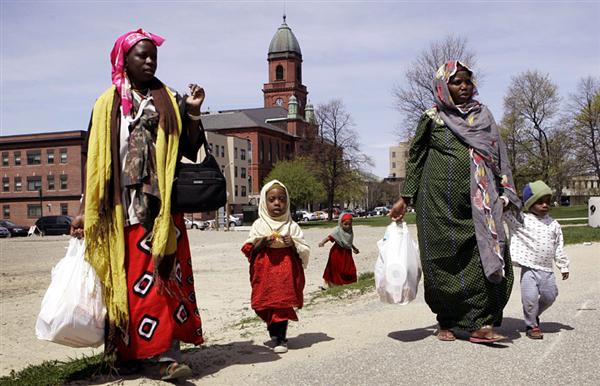
Immigrants from Somalia may sound like improbable rescuers for a place like Lewiston. Maine is one of the whitest states in the country, second only to Vermont, and its old families have a reputation for distinct chilliness toward "outsiders." And many of the immigrants spoke no English at all when they arrived. But even beyond the obvious racial, cultural and religious differences between the Muslim newcomers and the locals, the town's image had become so negative that it was hard to imagine people choosing to move there. "Nothing could have rightfully prepared them," says Paul Badeau of the Lewiston-Auburn Economic Growth Council. "And nothing could have rightfully prepared us, either." It wasn't easy at first. Townspeople feared for the few jobs that remained in the area, and they warned that the strangers would overload local social services. In 2002, the then Mayor Laurier Raymond wrote an open letter to the Somali community begging them to stop encouraging friends and family to follow them to Maine. But the Somalis kept coming, followed by Sudanese, Congolese and other Africans. By some estimates, 4,000 new immigrants have moved to Lewiston since 2001, and dozens are still arriving every month. Eight years ago, the town's adult-education center had only 76 students learning English as a second language. Now some 950 pass through every year. "This is just the teeniest little part of what has happened to the city," says the center's coordinator, Anne Kemper. "Everybody has had to scramble." Today, Somali women and children in donated winter parkas carefully navigate the snowbanks in the town's formerly crime-ridden low-income residential area. The center of town still has pawnbrokers and bars, but now there are also shops with names like Mogadishu and Baracka, with signs advertising halal foods and selling headscarves and prepaid African phone cards. "Generally, refugees or migrants that come into a town give a new injection of energy," says Karen Jacobsen, director of the Forced Migration Program at Tufts University's Feinstein International Famine Center. "Somalis particularly. They have a very good network [with strong] trading links, and new economic activities they bring with them." Retailers sell clothes and spices imported from Africa; other entrepreneurs have launched restaurants and small businesses providing translation services, in-home care for the elderly and other social services. There's even a business consultant. "Increasingly, there's an acceptance that immigration is associated with good economic growth," says urban-studies specialist Richard Florida, director of the University of Toronto's Martin Prosperity Institute. "How is Maine going to grow? It's a big state with a sparse population. One of the ways to grow quickly is import people." Commerce isn't all the Somalis are reshaping. Maine has America's highest median age and the lowest percentage of residents under 18. Throughout the 1990s, the state's population of 20- to 30-year-olds fell an average of 3,000 a year. Demographers predict that by 2030, the state will have only two workers for each retiree. "In many small Maine towns they're looking at having to close schools for lack of schoolchildren," says State Economist Catherine Reilly. "It will snowball. Right now we're seeing the difficulty of keeping some schools open; in 10 or 15 years that's going to be the difficulty of businesses finding workers." The same ominous trend is seen in other states with similarly homogenous demographics and low numbers of foreign-born residents—states like Montana, North Dakota and West Virginia. Reilly adds: "If you told a demographer just our racial composition, they would be able to guess that we're an old state with a low birthrate." Lewiston's sudden jolt is reflected even in enrollment at local universities. Although University of Maine enrollment has dropped systemwide since 2002, the student population at its Lewiston campus jumped 16 percent between 2002 and 2007. And Andover College, which opened a campus in Lewiston in 2004, had to start expanding almost immediately to accommodate a boom in applications. Enrollment doubled in two years. The reason? "Young people didn't want to go to a place that's all white," says Morrison. Practically everyone in Lewiston credits the Somalis' discovery of their town with much of its newfound success. "It's been an absolute blessing in many ways," says Badeau. "Just to have an infusion of diversity, an infusion of culture and of youth. Cultural diversity was the missing piece." The question is whether the rest of Maine—and other states like it—can find their own missing pieces. Source: Newsweek |
|---|

Gulf to face mighty All Blacks
Marcus Smith of Arabian Gulf, in white, takes on South Africa's Mzwandile Stick during the Emirates Airlines Dubai Rugby Sevens in November 2008. Arabian Gulf are in a pool with New Zealand, Italy and Tonga for the upcoming tournament. Randi Sokoloff / The National
DUBAI // The students, general managers and medical professionals who make up the Arabian Gulf sevens team will do battle against the best side in the world, New Zealand, on the biggest stage of all, at the World Cup Sevens in March.
The part-timers were pitched into a pool with the all-conquering All Blacks, as well as Tonga and Italy, when the draw was made for the March 7-9 competition at The Atlantis hotel on Monday.
Up until a few months ago they were competing for space with the public during their training sessions at Safa Park in Dubai.
In two months' time, they will be competing against some of the greatest names in the game.
Gordon Tietjens, the New Zealand coach, has been given special dispensation from his union to pick Super 14s players, including full All Blacks.
It is a treat he has rarely been afforded in the past, and he could bring the likes of Joe Rokocoko and Sitiveni Sivivatu, two of the most prolific try-scorers in the world game, to these shores.
While that is guaranteed to swell the attendances, it is also a daunting prospect for the Gulf players.
Andrew Cole, the newly installed chairman of the Arabian Gulf Rugby Football Union, said: "Realistically, going into the competition is going to be tough anyway, whatever draw we get. But for the guys to get the chance to play against someone like New Zealand is fantastic.
"On the World Cup stage as well, that will be the premier of anyone's rugby career. It is a great opportunity for the boys."
The Gulf are sending a squad to the Wellington Sevens at the start of February, where they will be competing in the invitational tournament while the likes of Tonga and New Zealand meet in the IRB Series.
While Italy remain an unknown quantity, the New Zealanders and Tongans are famed for their immense physical presence.
"We might have to hire a few more physios," joked Cole, the former Abu Dhabi chairman who has replaced David Skidmore at the union's chairman.
"Mike Lunjevich, the coach, has obviously done a brilliant job, and we have also brought in Charlie Keenan, a strength and conditioning coach from Scotland.
"That has really helped the guys and spurred them on, together with a great management team."
The last time the Gulf met New Zealand in competition, at the 2007 Dubai Sevens, they were trounced 64-0.
It marked the nadir for the region's sevens side, but their form since has prompted much reason for cheer.
Cole said: "At the last Rugby Sevens, a lot of people changed their attitude towards the Gulf squad and what they could actually achieve.
"We gave a couple of major nations a shock, and I think we can go that one step further at the World Cup.
"If we can take a game, that would be fantastic, but at the end of the day we want to go there and show that we can be a nation who should be taken seriously."
http://samotalis.blogspot.com/
28 January, 2009
Ahmadinejad demands US change, apology
| Ahmadinejad demands US change, apology Wed, 28 Jan 2009 14:09:00 GMT | |
Iran's President has welcomed an overture by the new American administration, which has promised of "change" toward the Iranian nation. http://samotalis.blogspot.com/
|

Why the BBC is wrong over the Gaza appeal
Director general Mark Thompson last week decided not to allow a broadcast by the Disasters Emergency Committee (DEC), an umbrella group of charities, calling for donations to its Gaza relief fund. His reason, supported by chief operating officer Caroline Thomson, is that such a broadcast would risk undermining public confidence in the corporation's impartiality.
That might feasibly be true if it could be shown, or even credibly argued, that the broadcast was anything other than a genuine humanitarian appeal; if there was evidence that the DEC was intent on mobilising people's charitable instincts for some covert political end. But there is no such evidence.
An alternative interpretation, and one that is ultimately much more damaging to the BBC's reputation, is that any humanitarian intervention in Gaza, by definition, expresses a political position in the long-running conflict between Israel and the Palestinians. In other words, collecting charity for Palestinians is a kind of hostility to Israel.
By that logic, there can never be victims in a war zone, even among civilians, since to designate anyone as such would offend one of the combatant sides. That is patently absurd and inhumane.
Mr Thompson's decision is also quite insulting to the BBC's audience. It implies that viewers might fail to distinguish between a charity appeal and a political message, so it is best not to broadcast the former in case it is mistaken for the latter.
Maintaining impartiality in the Middle East conflict has never been easy for the BBC. Israeli and Palestinian groups both regularly accuse the corporation of institutional bias, which is probably a crude indication that, in its journalism, the BBC gets the balance about right. But the decision over the DEC appeal was taken not by journalists, but by managers.
If the BBC now shows the appeal, as it should, it will doubtless be accused of caving in to political pressure. Thus, not for the first time, the corporation has manoeuvred itself into controversy where, whatever its next move, it cannot win. And, not for the first time, the fault lies not in bad journalism, but weak management.
http://samotalis.blogspot.com/
Egypt aired its grievances against Iran, the Palestinian Islamist movement Hamas
"(They tried) to turn the region to confrontation in the interest of Iran, which is trying to use its cards to escape Western pressure ... on the nuclear file," Foreign Minister Ahmed Aboul Gheit said in an interview with Orbit satellite channel broadcast Wednesday.
Aboul Gheit also said that Egypt undermined Qatar's attempts to arrange a formal Arab summit on Gaza earlier this month, arguing that it would have damaged "joint Arab action."
"Egypt made the summit fail... This summit, if it had taken place as an Arab summit with a proper quorum, would have damaged joint Arab action. We can see what others do not see," he said.
The interview was broadcast Tuesday evening and Wednesday morning and the state news agency MENA carried excerpts.
The comments are the first acknowledgement by Egypt that it actively sought to prevent the Doha summit on January 16, which was the subject of a bitter tug-of-war between rival Arab states.
It also indicated that a reconciliation meeting in Kuwait last week between Egypt and Saudi Arabia on one hand, and Qatar and Syria on the other, had only a short-term effect.
Qatar failed to win enough support to hold a formal Arab League summit on Gaza but it went ahead anyway with an informal consultative meeting of Arab leaders.
The wrangling reflected deep divisions between Arab governments. On one side Saudi Arabia and Egypt, wary of the Islamist group Hamas in Gaza, favored discussing Gaza at a separate economic summit in Kuwait a few days later.
Diplomats say Egypt resents the Qatari challenge to its traditional role as leading Arab mediator and dislikes the influence of the satellite television channel Al Jazeera, which is based in Doha and owned by the Qatari government.
"Some people imagined that a satellite channel could bring down the Egyptian state, without realizing that Egypt is much stronger than that," Aboul Gheit said.
"Egypt is very big and has extensive influence despite attempts to influence this stance and role, whether in the Al Jazeera channel or other channels," he added.
The Egyptian minister also criticized Hamas for what he called its coup against the forces of the Palestinian Authority in the Gaza Strip in 2007.
(Writing by Jonathan Wright; Editing by Samia Nakhoul)
http://samotalis.blogspot.com/
Saudi Arabia Ministry clarifies news reports on Gitmo returnees
An Interior Ministry spokesman said the Kingdom had made every effort to rehabilitate the terror suspects by providing them with necessary counseling. “In all 218 terror suspects, including Guantanamo returnees, have benefited from this program,” the spokesman said, while commenting on media reports that two Saudis who had spent time in the US prison camp in Cuba, had joined Al-Qaeda groups abroad.
“
These reports show that Saudi society is totally against the deviant group and will not allow them to operate within the Kingdom,” he said, adding the action of such Guantanamo returnees could affect the release of remaining prisoners.
Nuha Adlan Arab News
http://samotalis.blogspot.com/
BBC staff protest over decision not to show Gaza aid appeal
The BBC is facing a growing revolt from its own journalists over its decision not to broadcast the Gaza humanitarian aid appeal, with sources reporting "widespread disgust" within its newsrooms.
BBC staff have said they have been told they face the sack if they speak out on the issue and MediaGuardian.co.uk understands that corporation journalists will tomorrow vote on a resolution put forward by the National Union of Journalists condemning the move.
Sources have said there was "fury" at the BBC News morning meeting today about the decision, with news editors saying they had not been consulted on the move not to show the Disasters Emergency Committee appeal, which is to be broadcast tonight on ITV, Channel 4 and Channel Five.
The NUJ and fellow broadcasting union Bectu both passed motions over the weekend condemning the BBC's decision. NUJ general secretary Jeremy Dear and his counterpart at Bectu, Gerry Morrissey, will also today send a letter to BBC director general Mark Thompson asking him to review it.
Tomorrow the main NUJ chapel at BBC Television Centre will also meet, with staff expected to condemn the decision.
"Feelings are running extremely high and there is widespread disgust at the BBC's top management," one BBC News source said. "There is widespread anger and frustration at the BBC's refusal to allow people to speak out about it."
An NUJ source added: "It is the BBC's decision and we respect the independence of that, but we think they have got it wrong and should review it."
Thompson has said the corporation will not screen the DEC appeal because it could harm the BBC's impartiality on the Gaza conflict.
BBC management have said they will not change their mind on the issue and were backed by Sky News today when the satellite broadcaster also said it would not air the film.
The two-minute appeal is currently being edited by ITN and will be shown on ITV1 tonight before the main news at about 6.25pm, before being broadcast on the other channels.
Sources within the BBC have questioned whether its internal Balen report into its Middle East coverage, which the corporation has refused to publish, has influenced its decision on the DEC appeal. An appeal to the House of Lords to force the BBC to publish the report is currently ongoing.
Leigh Holmwood guardian.co.uk
http://samotalis.blogspot.com/
Site of Somali Government Is Put Under Islamic Law
The Shabab, one of the most militant Islamist militias fighting for control of the country, captured the town, Baidoa, on Monday, hours after the withdrawal of the Ethiopian troops who had been protecting it.
Speaking to thousands of spectators at a soccer stadium in the northeastern part of town, the Shabab spokesman, Sheik Muktar Robow, urged calm and ordered an end to the looting that took place on Monday.
"I want you to be calm," said Sheik Muktar, also known as Abu Monsur. "From today on, Islamic Shariah law will be the rule of this town. If anyone opposes the Shariah, appropriate steps will be taken."
In addition to Baidoa, a market town that has served as the seat of Somalia's transitional government, the Shabab controls most of Mogadishu, the main city and official capital, and much of the southern part of the country. The Shabab, listed by the United States as a terrorist organization, seeks to turn Somalia into an Islamic state under its particularly strict brand of Islamic law.
Sheik Muktar, whose speech on Tuesday was broadcast on the radio in Mogadishu, also ordered Baidoa residents to turn over any looted property to the Shabab or face unspecified consequences. The offices of the transitional government were looted and ransacked Monday after the Ethiopian troops left, a witness said.
The weak transitional government had been defended by Ethiopian troops since 2006 and supported by other countries in an effort to prop up an effective central government in a country that had not had one in 18 years.
But by the time the Shabab arrived in Baidoa, there was little government left. The president resigned last month. Most members of Parliament departed over the weekend for Djibouti, where they are taking part in United Nations-brokered peace talks and what now amounts to a shadow Somali government.
Once the Ethiopian military abandoned the town on Monday, the insurgents were able to take it without firing a shot.
The transitional government now controls only a few blocks in Mogadishu, although parts of Somalia are under moderate Islamist militias that support the government.
Several moderate factions have sent delegations to Djibouti, where they are working with the Parliament to establish a unity government based on a power-sharing deal made in October.
That process moved forward on Monday when the Parliament voted to expand its membership to add 200 legislators from the ranks of the moderate Islamists. The new members are to be sworn in on Wednesday, bringing the total number of seats to 550.
The Parliament also hopes to elect a new president within five days, according to local radio reports, to replace Abdullahi Yusuf Ahmed, a former warlord who was widely accused of trying to thwart peace negotiations and who resigned as president in December.
Around 3,000 African Union peacekeepers are in Somalia, trying to protect the few government enclaves. They have increasingly come under attack by the Shabab and other militias.
The Bush administration had pressed for a larger international force for Somalia, which it feared could become a base for Al Qaeda and other terrorist organizations. But the proposal met with little international support.
http://samotalis.blogspot.com/
Why Rwanda turned against Nkunda
Why Rwanda turned against Nkunda | ||
| ||
Boshoff talks about tthe implications of the additional joint operation by the Rwandan and Congolese armies to hunt down the Democratic Liberation Forces of Rwanda (FDLR), a rivial Hutu rebel group to the CNDP, whose members have been hiding in the DRC for 14 years after orchestrating the 1994 Rwandan genocide of Tutsis. Al Jazeera: It seems this joint operation between DRC and Rwanda is quite unprecedented. What has actually happened for these two neighbours who have been suspicious of each other, if not enemies, for many years to now work together? Well, it came as a surprise to everybody. I think the start of this co-operation was a month ago. There was an indication that there was a possible split within the CNDP. The CNDP chief of staff had indicated that he didn't agree any more with the policies of General Nkunda. The possible split in the CNDP had given an indication to the Congolese government that this is the time, maybe, to address the Nkunda issue. We also know that last Friday an agreement was signed between the government of the DRC and the breakaway faction under the leadership of chief of staff General John Bosco and all military commanders. Within three days, the Rwandans were crossing the border and were in the DRC. The Congolese government started talking to the Rwandan government on December 4 last year and agreed to carry out a joint operation against the FDLR. With a split in the CNDP, did Rwanda see Nkunda as a liability that needed to be dealt with right now? I think the concern was that Nkunda was becoming too ambitious [with] remarks that he was not interested any more in the stability and protection of the minority in North Kivu, but was interested in the whole of the DRC. He was saying he will protect the people of the DRC. I think that was of concern to Rwanda and this opportunity of a possible split in the CNDP prompted Rwanda to get rid of Nkunda. There had been a great deal of international pressure in 2008 to solve this problem. Can you give us an idea of how much pressure has been put on Rwanda and DRC to sort the CNDP and Nkunda out? I think the beginning of the end was last year when Nkunda overran North Kivu and chased the Congolese army. That's why Olusegun Obasanjo [a former president of Nigeria] was appointed by Ban Ki-moon [the UN secretary general] as an envoy to the Great Lakes region. But that process can close down; it's finished. The CNDP has given up and is going to be integrated into the Congolese army. What mechanisms are in place, if any, for Nkunda to be extradited to the DRC? I was listening to the [Congolese] minister of information Mende [Omalange] and he said they will now contact Rwandan authorities and try to get him extradited to Congo as soon as possible. They want to charge him before a military court for high treason and war crimes. The concern is that I am not sure if there is any agreement in place between the two countries. Secondly, if he is extradited and charged, what will the reaction in the DRC be? I am also concerned that it is not only General Nkunda who has to be charged. I think war crimes go back to 2004 and even before 2004, when General Nkunda was in RCD-Goma, one of the military factions. His commander, the current Congolese army chief, General [Gabriel] Amisi, was chief of the military area in Kisangani where people who mutinied were killed and thrown in the river. So the question will immediately be asked: What about General Amisi. But also what about Bosco? There is an international criminal court warrant of arrest for him. This is the biggest challenge now to come ... because I think the easy part is now over. Why are the Rwandans in the DRC? They are there to go after the FDLR. This is not the first time the Rwandans are in the DRC. The Rwandans were in Congo from 1996 to 2002, with more than 20,000 soldiers going after the FDLR and they couldn't get the FDLR. Now they have 3,500 to 4,000 soldiers and they say they need 15 to 20 days [to get the FDLR]. It does not make sense. I don't see how they are going to get the FDLR. The FDLR has been living in the DRC for 14 years. They are married to the Congolese. They have got their children there, and furthermore they also say they are preparing themselves. We know what happened last year when General Nkunda and the Congolese army put troops together to go after FDLR. It didn't succeed. It had to be stopped because 250,000 people were displaced and hundreds of people were killed. Monuc [the UN peace keeping force in the DRC] is bracing itself for a repeat of that. To make matters worse, Monuc is not part at all of this new joint operation. They have not been informed about it, and they are preparing themselves now for human rights violations and they know they have got the mandate and they must protect civilians. How are they going to do that? We are going to see tough times in the weeks to come. Aljazeera.ne | ||
| ||
|

This cowardly decision betrays the values the corporation stands for
Thompson spoke in reverential terms of Wheeler: his independence; his dislike of authority, any authority; his relentless search for the truth, in postwar Germany, in the United States of the 1960s and 1970s, LBJ, Vietnam, Nixon; in India, Kuwait, Kurdistan. Thompson was right. Wheeler was a giant among BBC journalists, rightly hailed as one of the best of his generation.
But even as Thompson spoke, the corporation was traducing every tradition that Wheeler, and many of us who still work for the BBC, have tried to live by. The corporation's chief operating officer, Caroline Thomson, had refused to allow it to broadcast an appeal on behalf of the Disasters Emergency Committee for Gaza. She said that one reason was that "the BBC's impartiality was in danger of being damaged". Could the BBC be sure, she added, that money raised for this cause would find its way to the right people?
How is the BBC's impartiality to be prejudiced by asking others to raise money for the victims of an act of war by a recognised state, an ally of Britain, using the most lethal armaments it can against a defenceless population? What sly little trigger went off in her head when Thomson questioned whether the aid would reach the right people? What right people? Hamas, the elected representatives of the Palestinian people? The hospitals and clinics run by private charities and the United Nations Relief and Works Agency? The mosques? The citizens of Gaza, persecuted beyond measure not only by their Israeli enemies but by the western powers who arm and sustain Israel and defy the democratic vote of the Palestinian people?
Is Thomson more fussed about some imaginary "war on terror" that even the new White House is shying away from than she is about upholding the free speech and freedom of action of the corporation?
This pusillanimous obeisance to some imagined governmental threat has aroused unprecedented anger across the BBC. Reporters and correspondents still on the staff, and who will not name themselves, are beside themselves with rage against a corporation that is traducing the very ideals it is supposed to uphold, and for which the director-general seemed to speak in Westminster Abbey.
This is what one former BBC World Service current affairs producer wrote to his colleagues yesterday: "... I am rarely moved to comment on aspects of the BBC I can no longer influence. But I confess I am deeply saddened and confused - and frankly pleased to be distanced from such decisions - after listening to Caroline Thomson's obfuscating defence on Today of the refusal to broadcast the joint charity appeal on behalf of the suffering in Gaza. The question of partiality is a red herring. It is for the general public to respond to a humanitarian disaster as they choose."
Having dealt with different news managers at the BBC over the past 30 years or so, I can safely say that the modern BBC has become a body of lions led by donkeys. Reporters of the calibre of Jeremy Bowen, David Lloyn, Lyse Doucet, experts in their field and brave people all, will be appalled by the directions they are being given. Edward Stourton and the Today programme rightly produced Tony Benn yesterday morning because they knew he would articulate what their bosses have failed to: reason and humanity.
The big question that remains is this: what are the suits scared of? Why do BBC managers try to second-guess our government and even outreach it in grovelling to the United States and Israel?
BBC journalists, extant and retired, not the "usual suspects", not disaffected radicals and high-octane lefties, are incandescent with rage over this extraordinary piece of institutional cowardice.
The episode makes a travesty of the institution's posturing in Westminster Abbey last week, and discredits the honest reporters the BBC still has on its books and in the field.
• Tim Llewellyn is a former BBC Middle East correspondent
http://samotalis.blogspot.com/