31 October, 2010

SOMALIA: UN ENVOY CALLS ON NEW PRIME MINISTER TO FORM GOVERNMENT

SOMALIA: UN ENVOY CALLS ON NEW PRIME MINISTER TO FORM GOVERNMENT
New York, Oct 31 2010 12:10PM
The United Nations envoy for Somalia on Sunday called on the country's new Prime Minister, Mohamed Abdullahi Mohamed, to form his government and move forward on meeting the challenges in the strife-torn Horn of Africa nation.

"I congratulate Prime Minister Mohamed and encourage him to form his government so that he can gain momentum in completing the critical tasks ahead during this transitional period," Augustine P. Mahiga, the Secretary-General's Special Representative, said in a news release issued after the new leader was confirmed.

Mr. Mahiga also acknowledged the support and close collaboration of the international community, the African Union and the Intergovernmental Authority on Development (IGAD) in supporting and encouraging the cohesion and coherence within the Somali transitional institutions.

Mr. Mohamed was named to the position by Somali President Sheikh Sharif Sheikh Ah
med two weeks ago, following the resignation in September of Omar Abdirashid Sharmarke.

The country, which has been torn apart by decades of conflict and factional strife, more recently with al-Shabaab Islamic militants, has not had a functioning central government since 1991. It also faces a dire humanitarian crisis in which 3.2 million people, more than 40 per cent of the population, is in need of aid.

30 October, 2010

Dutch parliament, German Chancellor: We're not anti-Islam


 Dutch parliament, German Chancellor: We're not anti-Islam


The Dutch parliament passed a motion (NL) today saying that the government should 'proclaim in word and deed that fighting Islamization is not a goal of the [gov't] policy." The only parties voting against the motion were the PVV and Christian SGP.

German Chancellor Angela Merkel, also denies she's anti-Islam. Via The Local:

The Dutch anti-Islam politician Geert Wilders on Wednesday angered German Chancellor Angela Merkel by provocatively praising her recent attack on multiculturalism.

Merkel's conservative Christian Democratic Union (CDU) had taken "leadership in the area of Islam criticism," Wilders told the Dutch parliament.

(...)

Merkel's spokesman, Steffen Seibert, angrily replied to Wilders' speech by saying that that the Chancellor had in no way expressed "criticism of Islam."

"That is not true. You cannot interpret the Chancellor as a critic of Islam because she naturally has respect for an important world religion," Seibert said in Berlin.


Midterm elections could give a boost to Africa - if the Democrats lose

Midterm elections could give a boost to Africa – if the Democrats lose
Christian Science Monitor
Many in Africa have been disappointed with Obama. In a Republican Congress, Africa could become a bigger foreign policy priority. US President Barack Obama ...

America in election mood

IN THE ECONOMIST THIS WEEK -


Democrats and Republicans made one final pitch to voters before America's MID-TERM ELECTIONS on November 2nd, in which Barack Obama's party is expected to fare badly. All 435 districts in the House of Representatives and more than a third of seats in the Senate are being contested, as well as 37 governorships. More than 100 state referendums will also take place, along with elections to state legislatures.

- See article

http://news.economist.com/cgi-bin1/DM/t/eCRBD0W6ztq0Mo0f860E5


Somalia women discuss peace and security challenges

Somalia women discuss peace and security challenges
HERE WE ARE
Delegates from Somalia at a UNIFEM gender forum in Nairobi
 
To commemorate the tenth anniversary of United Nations Council resolution on women, peace and security, grassroots women from Somalia participated in a consultative workshop sponsored by UNIFEM.

Meeting at Nairobi, Kenya, the delegates discussed various challenges facing Somalia women in light of political, social and economic situation in the country.

According to UNIFEM consultant in Somalia Charity E. N. 'Buga, the seminar discussed five key issues including protection of women from sexual violence, participation and representation of women decision making at all level.

Among the Speakers were Sahra Abtidon, Sheik Jacfar, Fowsia Adam, Ali Ismail, Sahro omar, Fardowsa Omar, Fardowsa Hassan and Sahara Mohamded Mahada'alla.

The Invention of Faisal Roble: The Manipulation of Mind and Media

The Invention of Faisal Roble: The Manipulation of Mind and Media

By Mohamed Haji (Ingiriis)

The great French playwright, Molière, once said, "Un sot savant est sot plus qu'un sot ignorant," which literally means, "An educated fool is more foolish than an uneducated fool." The Somali equivalent to this could be borrowed from Timacadde's "Doqonnimo kugu baahday, baan cidi dabiibeyne; dariiq toosan Soomaaliyey waa lagaa dadaye; dugsi ma leh qabyaaladi waxay dumiso mooyaane."

 Faisal Roble

One such Madaale pseudo-intellectual is Feisal Abdi Roble, editor of Wardheer Newswebpage, who recites what he frames 'Marxist School of Thought'. Perhaps, my father – to say the least – would not permit me to write this rebuttal to Faisal Roble (I should underline that my Dad was a senior student of Fulbright Scholarship at University of California at Davis in America when Faisal was a junior at University of California at Los Angeles. It was exactly when Dr Abdi Ismail Samatar was also a senior student there).

However, Faisal Roble, once branded 'Devil Clannish' by Somali blogger is, among other things, accustomed to discrediting certain individuals by means of clan sentiments. Over the years, I have observed him blemishing highly-reputed personalities, like President Ahmed Silanyo, President of Somaliland; Abdullahi Ahmed Addou, the longest serving Somali Ambassador to the United States; Ahmed Gure, founder of Hiiraan Online and Yusuf-Garaad Omar, Head of BBC Somali, for the sole reason of not hailing from his clan-family.

Needless to say (repeat) what he has written of them, because it is more on personal than on professional damage. In the words of Molière, "A wise man is superior to any insults which can be put upon him, and the best reply to unseemly behaviour is patience and moderation." On the other hand, Faisal's other routine work is praising Said Samatar, a Somali scholar; Hussein Abdilkadir Qasim, a former Minister, to mention just a few, for the type of Judge Hurshe's verdict: "La jiifiyaanna bannaan, la joojiyaanna bannaan!" In his last radio interview, Faisal has narrated what he framed "the biggest clans" against "not-so-big clans." Where did he obtain on this demographical census?

But by this time, Faisal has not only shaken minds, but body as well. On Saturday morning (October 23rd), inside a so-called Somali Intellectual Forum (transformed its name recently into Talo iyo Tusaale), Faisal Roble attempted to harm the reputation of Dr Ali Jimale Ahmed, Professor of Comparative Literature at the Graduate Centre of the City University of New York. He misled the audience that the title of the book 'The Invention of Somalia' by Dr Jimale was 'plagiarising.' He was applying with a concept by a Kenyan consultant who emailed me recently: "In Somalia, everyone enjoys to embarrass everyone."

 On the contrary, if truth be told here, there is no 'plagiarising' in the title of "The Invention of Somalia" whatsoever.  From the perspective of intellectual property law, the word 'plagiarising' is a very serious accusation that must be backed up at least one peace of evidence when it comes to criticising, or discrediting one's work. In this western world and Africa in particular, there are – merely to enliven Faisal's mind – a lot of books by the title of 'The Invention.'

For instance, the title of The Invention of Somalia, as Dr Ali Jimale Ahmed visibly alluded to the preface, was inspired by 'The Invention of Ethiopia' by Holcomb and Ibbsa. He even agreed with the respective authors when they wrote in their book, "No available treatment of the history of (Somalia) dealt adequately with the factors that shaped (Somalia), that is, factors that generated the political and economic relations still found there and which account for the conflict currently raging within (Somalia)."

 
There are, additionally, other books on African Studies entitled with below titles:


1.      The Invention of Africa: Gnosis, Philosophy, and the Order of Knowledge by V. Y. Mudimbe.

2.      The Invention of Africa and Intellectual Neo-colonialism by Jedi Shemsu Jewheti.

3.      The Invention of Ethiopian Jewish: Three Models by Steven Kaplan.


Moreover, other numerous international books outside African sphere are:

1.      The Invention of Barack Obama by David Remnick.

2.      The Invention of the Jewish People by Shlomo Sand.

3.      The Invention of Tradition by Terence Ranger and Eric Hobsbawm.

4.      The Invention of Hugo Cabret by Brian Selznick.

5.      The Invention of Morel by Adolfo Bioy.

6.      The Invention of Objectivity: Aaron Swatz's Raw Thought by Robert McChesney.

7.      The Invention of Net Neutrality by Nancy Scola.

8.      The Invention of Lying: A comedy movie by Ricky Gervais and Matthew Robinson.

Consequently, in Faisal's eyes, are they all exercising a 'plagiarising'? To be more precise, what about the other books – referenced frequently in African Studies – with the same titles and analogical contents? Below is an example:

       I.            The Black Man's Burden: Africa and the Curse of the Nation State by David Basildon.

    II.            The Black Man's Burden by Edward D. Morel.

 III.            Black Man's Burden by John Oliver Killens?

Are they too 'plagiarising' each other? Indeed, there are a lot of books with the same titles, but just to mention a few must be suffice.

When President Obama added on one of his speeches to this passage, "I believe the nation that invented the automobile cannot walk away from it", an American blogger wrote an op-ed piece entitled: "Obama and the Invention of the Automobile," reminding the US President of the veracity that the nation who had invented automobile was Germany, not the United States of America.

If there is a book about Somalia, to my knowledge, that sounds like a work whose name had stolen from other title – whether it is chance or intent – is the book by David D. Laitin and Said S. Samatar entitled "Somalia: Nation in Search of a State," which was written in 1987. To get the point across, in 1967, Dr Hussein M. Adam, popularly known as Hussein Tanzani, had named one of his two MA Thesis: Somalia: Nation in Search of Transcript at University of Makarere in Uganda (Dr Tanzani later earned his Ph.D. from Harvard – the first Somali who did Ph.D in Harvard).

Nonetheless, The Invention of Somalia, edited by Dr Jimale, is one of the best books that ever written on Somalia. It is a direct theoretical and empirical contribution to Somali Historiography, and that is noticeably what led the authors to write: "The denial of recognition to other Somali freedom fighters and their movements has to be seen as public denial that is directed against the clansmen of the spurned martyrs."

The first real attempt of The Invention of Somalia, as Dr Jimale summarised, is to identify and analyse the basic assumptions which had informed the construction of the now debunked myth of homogeneity. The authors do not only suggest, as they write, alternative ways of seeing and interpreting existing data, but also initiate and propose new ways of reading Somali past and present.

In John Killens' Black Man's Burden, a father tells his bewildered son that stories about various life-and-death struggles between a man and lion will always end like the man beating the lion (or defeating, to add my view) until the lion learns how to write. This lion's version of what had happened in (Somali) history, to quote from Dr Jimale, has in Somalia and beyond, for a long time, belonged to an underground narrative.

It is here that the two brothers – Dr Mohamed Enow and Dr Abdikadir Enow, both Bantu scholars, whom Faisal also attempted to no avail to discredit their work – deserve my gratitude for having mustered the bravery to re-examine what Dr Jimale portrays 'the Dervishization' of Somali Studies. In my viewpoint, this is to confront with the history of oppressed as written by their oppressors, and it shapes the consciousness and psychology of both oppressed and oppressor.

To manipulate History, Amos Wilson warns, is to manipulate consciousness, to manipulate consciousness is to manipulate possibilities, and to manipulate possibilities is to manipulate power. Herein lies how the autocracy had ruled Somalia for two decades. It is a call for the re-conquest of Somali minds and bodies. One Africanist scholar contends, "The most valuable resources (of human-being) are their knowledge of truth and reality of identity, minds, bodies and souls."

What Enow brothers – with Dr Jimale – are digging for is new thought for Somalia, looking for an invented (or reinvented) Somalia. It appears that Enows dedicated their lives to their people who were never permitted before a place or space, let alone a chapter, for Somali Historiography when myths likea Pastoral Democracy was dominating Somali Studies. Thanks partly to academics like Catherine Besteman, Francesca Declich and Virginia Luling, among others, their history was invented, yet contemporary Somali thought (and theme) seems to be intrinsically a product of the pastoralist proponents. Until very recently, the history of some Somalis among us was persona non-grata in Somali Historiography.

Lee Cassanelli, in The Shaping of Somali Society, came to a comparable conclusion: "Somali Society ought to be regarded as the product of interactions among small groups of herdsmen, farmers, itinerant Sheikhs, and townsmen who came together under diverse circumstances in the past and whose modern sense of national identity derives less from primordial sentiments than from a set of shared historical experiences."

Alas, there are some new Somali graduates who see Faisal Roble as an intellectual, but the term itself entails to be defined. As they say, "Not every educated is intellectual, but every intellectual is educated." In Somali way of thinking, an intellectual is simply an ordinary person, not necessarily a tweedy-Kantian. William Finnegan contended in an article on New Yorker that "Somali intellectuals" are "just people with degrees."

This is how Dr Jimale defines intellectual persona: "An intellectual (of any sort) is the person who, to quote from Gramsci, 'assumes that the purpose of discussion is the pursuit of truth.' Such an intellectual is one who attempts to identify problems, reflects on them, and does not shy away from asking hard and unpleasant questions and who suggests, not imposes, some type of solution the problem under scrutiny. An intellectual is also the one who understands the validity of Somali poet… Chinese adage, to know and not to act is not to know. The trouble with Somali intellectuals emanates from what Hisham Sharabi calls 'a fetishized consciousness' which manifests itself in both imitation and passivity."

As for the question of Somali irredentism, which Faisal mentioned, one may enjoy reading BANDITS ON THE BORDER: The Last Frontier in the Search for Somali Unity by Nene Mburu which is a first insider's analysis of Somalia's peculiar pursuit of Greater Somalia. I presume many have enjoyed reading Saadia Touval's Somali Nationalism, so is the one by Mburu. Charles Seymour said, ""We seek the truth, and will endure the consequences."

My final amusement to 'startle' Faisal must be on those shocking lines: What about your favourite bookNomad Diaries by Yaasmiin Maxamuud, published in 2009? Wasn't she plagiarised her title by the book with the same title: The Nomad Diaries by Chris Minh Doky, published in 2007, or, is the name emanated from Urban Diaries by Walter Hood and Leah Levy, published in 1997? Pardon me, we need elucidation, man!

By Mohamed Haji (Ingiriis)

Email: Ingiriis@yahoo.com

29 October, 2010

BAN CALLS INTIMIDATION OF UN-BACKED LEBANON TRIBUNAL ‘UNACCEPTABLE’

BAN CALLS INTIMIDATION OF UN-BACKED LEBANON TRIBUNAL 'UNACCEPTABLE'
New York, Oct 29 2010 11:10AM
Secretary-General Ban Ki-moon condemned this week's attack against three staff members of the United Nations-backed tribunal set up to try suspects in the 2005 murders of former Lebanese Prime Minister Rafiq Hariri and 22 others, calling such acts of interference and intimidation "unacceptable."

The Special Tribunal for Lebanon, Mr. Ban stressed in a statement issued by his spokesperson yesterday, is an independent court set up at the request of the Lebanese Government and with a clear Security Council mandate.

"It is an important tool to uncover the truth and end impunity," he <"http://www.un.org/apps/sg/sgstats.asp?nid=4885">said.

On Wednesday, two investigators from the Office of the Prosecutor of the Special Tribunal and their interpreter were attending a pre-arranged meeting at a doctor's office in Beirut as part of the investigation when a large group of people "showed up unexpectedly" and violently attacked the three staff, the Office said in a news release.

According to the Prosecutor's Office, several items belonging to the staff were stolen during the attack. The Lebanese army extracted the three staff members and brought them back safely to the Tribunal's office where they were provided with medical attention.

In his statement, the Secretary-General called on all parties to refrain from interfering in the Special Tribunal's work and from prejudging its outcome.

He also underscored the importance of The Hague-based Special Tribunal carrying out its work safely and securely, commending Lebanese authorities for their swift action in opening an inquiry into the Wednesday incident.

The Prosecutor's Office denounced the use of violence, emphasizing that the investigation into the Hariri attack will continue undeterred by Wednesday's incident.

The Tribunal is an independent body that was set up following a probe by the International Independent Investigation Commission (<"http://www.un.org/news/dh/docs/mehlisreport/">IIIC) after an earlier UN mission found that Lebanon's own inquiry into the massive car bombing in February 2005 that killed Mr. Hariri and the others was seriously flawed and that Syria was primarily responsible for the political tensions that preceded the attack.

The investigation of the murders is being carried out under the guidance of the Tribunal's Prosecutor, Daniel Bellemare, a Canadian prosecutor and former head of the IIIC.

Somali author Nadifa Mohamed up for first book prize

Somali author Nadifa Mohamed up for first book prize

Mohamed's debut novel Black Mamba Boy is published by HarperCollins

An author born in Somalia has been shortlisted for the 2010 Guardian First Book award.
Nadifa Mohamed, who spent her early years in Hargeisa, Somaliland, before moving to the UK, is cited for her debut novel Black Mamba Boy.

The book, which describes a journey from her Somalian homeland to Port Talbot in Wales, is also shortlisted for this year's Dylan Thomas Prize.
The winners of both literary prizes will be announced on 1 December.

Black Mamba Boy is one of three novels and two non-fiction works in the running for the Guardian's £10,000 prize.
Also in contention are Boxer, Beetle by Ned Beauman, about a boxer living in the east London of the 1930s, and Your Presence is Requested at Suvanto, a novel by Maile Chapman set in a women's sanatorium in Finland.

The non-fiction works shortlisted are Being Wrong: Adventures in the Margin of Error by Kathryn Schulz, and Romantic Moderns by Alexandra Harris.

The former is a study of why human beings make everyday errors, while the latter is subtitled English Writers, Artists and the Imagination from Virginia Woolf to John Piper.
Clare Armitstead, the Guardian's literary editor, said the shortlist "reflects one of the year's big literary themes - how to tell stories in our new era".

Actress Diana Quick, journalist Ekow Eshun and the novelist and poet Adam Foulds are among those who will join her on the judging panel.
Last year's winner was Petina Gappah for her short story collection, An Elegy for Easterly.

Mohamed is one of six writers up for the £30,000 Dylan Thomas prize, presented each year by 
the University of Wales.

Girls killed by Islamist firing squad in Somalia

Girls killed by Islamist firing squad in Somalia

Victims reported to be 18 or younger were shot in front of hundreds of residents in Beledweyne, near border with Ethiopia
Islamic gunmen patrol in Mogadishu, Somalia
Xan Rice in Nairobi and agencies
guardian.co.uk
Article history

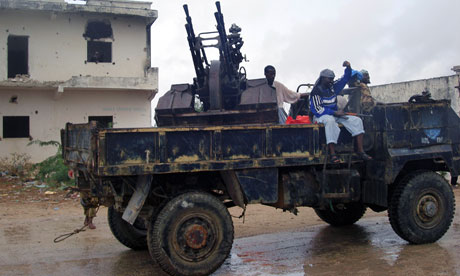
Islamist militants in Somalia. The al-Shabaab rebel movement has shot dead two young girls in the country after accusing them of spying for the government. Photograph: AFP/Getty Images

An Islamist militia in Somalia has publicly shot dead two teenage girls by firing squad after accusing them of spying for the government, it emerged today.

The victims – reported to be 18 or younger – were killed in front of hundreds of residents in Beledweyne, near the border with Ethiopia.

The town is controlled by the hardline al-Shabaab rebel movement, which has become notorious for its extreme form of punishment, including stonings and cross-amputations, for various crimes, usually adultery and theft.

The killings, which happened on Wednesday, are believed to the first instance of any females in Somalia being executed for spying. The girls' relatives denied they were guilty of the charge.

According to eyewitnesses accounts, a Shabaab "judge" sentenced the girls to death shortly before they were executed. No evidence was presented, and the two were not allowed legal representation.

Militiamen then used pickup tricks with loudspeakers on the back to summon residents to attend the ceremony at the Islamists' headquarters. They were warned not to take mobile phone pictures.

The girls – named by the Associated Press as Ayan Mohamed Jama, 18, and Huriyo Ibrahim, 15 – were brought to the site blindfolded, with their hands bound. They were made to sit on the ground. About 10 masked men then shot them.

"Two very young girls were shot ... and no one could help," Dahir Casowe, a local elder, said.

After the execution, the local Shabaab commander, Sheikh Yusuf Ali Ugas, told the crowd that Islamist fighters had arrested the girls last week. He claimed hey had confessed to the crime, and said dozens of other people in custody faced a similar fate.

The girls reportedly came from poor families, and had not been attending school due to a lack of funds.

Ayan's father, Mohamed Jama, confirmed that his daughter had been in custody for a week, and said he had been refused permission to visit her.

"Al-Shabaab officials ... told me that she was captured during fighting between the militants and the government soldiers outside the town and that she would be brought before court," he said. "As I waited for good news, she was killed on Wednesday. I am shocked and cannot say more."

The public punishments have a duel purpose for the Shabaab – to restore security in areas under their control by deterring would-be criminals, and to create a climate of fear so locals are too terrified to show dissent or offer support to the government.

Together with another Ismalist militia, Hizbul Islam, Shabaab fighters are trying to overthrow President Sheik Sharif Ahmed's weak administration, which is protected in Mogadishu by 8,000 African Union peacekeepers.

Infighting among ministers and the inability to provide even basic services on the ground has lost the government the sympathy of most Somalis and allowed insurgents to take over much of south and central Somalia since early 2009.

But the Islamists' extreme version of the their religion, which runs counter to Somali tradition, has seen their own support whittled away.

In a statement condemning the executions, Somalia's information ministry said: "This act of killing innocent children does not have Islamic and humanitarian justifications.

Finland: Immigrant Males Struggle to Find Friendships with Finnish Men

Finland: Immigrant Males Struggle to Find Friendships with Finnish Men

Via YLE:

Immigrant males frequently find it hard to strike up friendships with Finnish men. Such friendships facilitate better integration both for the men themselves and for their families. Helsinki City officials plan to increase programmes targeted at the immigrant male population.

Two organisations aimed at the social empowerment of men, Miessakit and Semo, organise conversation groups which bring together immigrant and Finnish men. Many topical issues are discussed and it is also an opportunity to learn Finnish.

"Here we have the time to talk and exchange views. There isn't normally time for that at work or college. We can talk about many things here–prejudices disappear and we also get to understand each other's culture," says Ali Hussein from Semo.

There are still very few activities for male immigrants in Finland. Such programmes are nevertheless needed, as men's issues can differ significantly from those of their female counterparts.


View article...

28 October, 2010

Prophet Muhammad — 22 : Handling explosive situations

Prophet Muhammad — 22 : Handling explosive situations
ArabNews

One thing that stands out when we study the character of Prophet Muhammad (peace be upon him) is his natural ability to handle explosive situations. When competition is keen, honor is at stake or a feeling of injustice is nurtured, great care should be exercised in order to defuse the situation. Whenever a situation threatened to go out of control, the Prophet displayed cool wisdom that was certain to prevent a potential disaster. This came to him naturally, displayed long before he became a prophet.

A few years before his prophethood, when the people of Makkah pulled down the Kaaba and rebuilt it, a dispute arose as to which of their clans should have the honor of putting the Black Stone back in its position. This was considered a matter of great honor, and each clan wanted it. The whole community attached great importance to every honorable action. Therefore, none of them was ready to allow the others that privilege without first putting a fight for it. Several days of arguments could not settle the matter and tempers rose sharply. The situation threatened to develop into a bloody conflict. However, someone suggested that they should agree on arbitration and the arbiter turned out to be Muhammad (peace be upon him).

When the dispute was put to him, he realized that no one was prepared to give in. Therefore, he sought to satisfy everyone. He placed a robe on the ground and put the Black Stone in the middle. He asked the chiefs of all clans to hold the robe and lift it. As they moved to the right corner, they lifted the robe up to the right level. Muhammad then took the Black Stone and placed it in position. He did so as the arbiter, and as such he was not representing his own clan. Thus, no clan could claim a special honor in the process, none was left out. Another situation occurred on his arrival in Madinah. There were two major Arab tribes in Madinah, the Aws and the Khazraj, each of which included several clans. Rivalry between the two tribes was fierce. Only a few years earlier they went into a five-year war against each other. Moreover, within each tribe, its clans sought to add to what brings it honor and pride. As the Prophet arrived in Madinah, each clan wanted to be his host. What could bring them more lasting honor than to be the hosts of God's messenger? He would be receiving God's revelations in their midst. Therefore, every single clan invited him to be their guest, promising protection and hospitality. Any choice the Prophet made would have delighted some of his supporters and dismayed others. He could not wish to make such a choice at the very beginning of his stay in Madinah, where he was in effect seeking refuge.

The Prophet simply released the reign of his she-camel and told his eager hosts that the camel had its orders. Thus, he moved in Madinah, allowing his she-camel free reign while people cleared the way for her. At one point, she sat down close to a solitary house. The owner, Abu Ayyub, came out, overjoyed and took the Prophet's little luggage inside. The Prophet was to be his guest until he has had suitable accommodation of his own. Thus, no jealousies were allowed to creep in. The Prophet did not favor one clan over another. It was an aspect of the Prophet's wisdom that he would look for whatever was certain to maintain good feelings among people so that there would be no room for rivalry or conflict.


It is through community service that we can be good Muslims’

It is through community service that we can be good Muslims'

By SIRAJ WAHAB, SIRAJWAHAB@ARABNEWS.COM

The toughest thing about interviewing Princess Reema bint Bandar bin Sultan Al-Saud is getting her to talk about herself as at present she is focused on the upcoming Oct. 28 attempt to set the record for creating a human ribbon of thousands of women to raise awareness in Saudi Arabia about breast cancer.

"We are basically creating what we hope to be a momentous event in the Kingdom to gather women to break the Guinness World Book record for the largest human-awareness ribbon," the princess told Arab News in an exclusive interview. "What that means is that it will be in the shape of a ribbon made out of women. The record is about 3,700 plus. Our goal in fact is not just to gather 3,700 plus women but, I hope, 10,000 women."

The daughter of the longtime ambassador to the United States Prince Bandar bin Sultan, Princess Reema's mother is the daughter of the late King Faisal. Raised and educated in Washington, D.C., the princess earned a bachelor's degree from George Washington University. Upon her return to Saudi Arabia in 2002, she partnered in Yibreen, a well-received women's day spa. She now is president and CEO of Alfa International and Al-Hama LLC, two leading luxury retail corporations based in Saudi Arabia. The groups manage brands including Donna Karan and DKNY in the Middle East and operate the Harvey Nichols department store in Riyadh.

She is also a member of the board of advisers of the nonprofit Institute of Civil Leadership, an organization founded to inspire and to educate students to be global leaders, and a founding member of the Zahra Breast Cancer Association, which has provided her recent focus.

"This is the first time that I am organizing an event of this size," she said. "We have been working with some amazing corporate sponsors. This will also benefit the Zahra Association to generate awareness about breast cancer. The event is being held under the patronage of Sultan bin Abdul Aziz Foundation. They have been extremely supportive of our activity. Our main focus is to generate awareness about breast cancer."

She said she hopes the event will help women to better protect themselves against breast cancer, which has been a difficult subject for many women to talk about. "I would just like to have the word breast cancer mentioned so that women can check themselves, think about it and talk about it in any way they can so that we can generate that conversation," the princess said. "Perhaps it will reach one woman who has never heard of breast cancer and has never checked herself up. If that happens then we can take immense comfort."

She praised governmental and health-sector efforts to promote awareness about breast cancer but acknowledged that the Kingdom's vast area and diversity created special challenges.

"The efforts of the Health Ministry in conjunction with private clinics and charities such as Zahra Breast Cancer Association have made great strides in generating awareness on breast cancer. Where we are today obviously is not where we should be, which means we have a very long road ahead of us," said Princess Reema. "Our point of view is that no woman should die of breast cancer. The way to stop the spread of breast cancer is through early detection because if a woman detects it in Stage 1 or Stage 2 it is curable. Unfortunately, the farther out you go from the larger cities the less aware the ladies are. That is what makes the work of foundations like Zahra very important because we are women going out and talking to women. This is always the most acceptable way to get the message out just because of the sensitivity of this particular subject."

Princess Reema said the private sector and the government have been very supportive of the foundation's breast cancer awareness initiative. "The public and nonpublic response and support for our cause has been immense. Mobily has been extremely supportive of us along with Avon, MBC, Almarai, Riyad Bank, Burger King, The Jeddah Hilton, Napco, Donna Karan and DKNY — there is a long list," she said. "I cannot thank the companies that have supported us enough. Without their support it would not have been possible for us to come this far nor would we be able to do the activity we are doing. The Health Ministry also has been extremely supportive, and the Ministry of Social Affairs has extended us all help."

She also noted the enthusiasm of young Saudis in moving the initiative forward. "If you take a look at our Facebook page — honestly, that is the way all of the young people seem to communicate — the response is overwhelming," said Princess Reema. "We have had encouraging words not only from the young people within the Kingdom but also from people outside of the Kingdom. The numbers of those who have visited our site and responded to the call are honestly astounding. The goal is to create awareness and to let people know that breast cancer doesn't know a country; it doesn't know a race; it doesn't know a religion. It is a disease that affects people across the world. If we are able to make an impact on people at the other end of the globe in making them aware of breast cancer, honestly, that is a phenomenal experience."

There is a broader message that people can take away from the campaign, and Princess Reema hopes to send a message to many women and young people across the country.

"Be aware of your health, and be aware of the health of those around you," she said. "Spread the word about breast cancer — talk about it. Think about it because it is something that is easily curable if found out in the early stage. We would be very happy to receive every woman to come and stand with us on Oct. 28. We look forward to seeing everybody in Jeddah. My whole family will be there, from my mother to my daughter, to my sister, my friends and I hope many, many of my countrywomen."

The location of the event was somewhat sensitive, as many Saudi women would be uncomfortable were probing eyes allowed to gaze upon them. Princess Reema said at the Ministry of Education Sports Compound in Jeddah's Al-Rawdah district near the H Bridge satisfied those requirements. "You know, here in the Kingdom privacy is extremely important for the ladies, so we wanted to host it in a location that would enclose a large number of ladies and one that was not surrounded by high buildings," she said.

When asked where she got the motivation to get so involved in nonprofit, community-service work, Princess Reema said it was a family tradition — from both sides of the family. "This inspiration to be proactive in the community is one that I learned from both my parents and my grandparents on both sides. It is a part of the ethics with which we were raised as Muslims, as Saudis and as Arabs. It is in our nature. It is nothing unique or particular to my family. It is in our nature. It is through such acts that we can be good Muslims."

SUDAN: Noor El Sham, "It is not okay for a man to abuse me"

SUDAN: Noor El Sham, "It is not okay for a man to abuse me"

NYALA, 28 October 2010 (IRIN) - Survivors of sexual and gender-based violence in Darfur not only suffer the psychological consequences but also have to contend with a weak judicial system. A culture of impunity means survivors are reluctant to speak out and can find themselves ostracized from their communities.

 There is little access to medical and psycho-social support following the expulsion of international NGOs in early 2009. A State Committee on Sexual and Gender-based Violence has also done little to provide care because of a lack of funds, and numbers of female police are inadequate.

 Noor El Sham, 25, from El Fir Dos village east of the South Darfur capital, Nyala, was subjected to domestic violence and jailed after killing her husband in self-defence. El Sham shared her experience with IRIN:

 "I was 14 when I got married and did not know much of what I was getting myself into; my family decided who I was to marry.

 "My husband was a lot older than me and from the start of our relationship he used to beat me, often for no reason, or none strong enough to justify how brutal he was. I tried speaking to my family about my husband's abuse but was told to stop complaining, to consider myself lucky for having a husband.

 "Divorcing him was not an option. If I had gone to court or if I had reported him to the police, no-one would have believed me anyway. They would have said I was probably either a bad wife or worse, guilty of adultery.

 "Two years after we got married, when I was only 16, he tried to strangle me. I stabbed him to death with a knife defending myself. I hated him for what he had done to me but I did not want to kill him.

 "I was sentenced to jail but could have been released after paying a 5,000 SDG [US$2,112] fine but I had no money.

 "I was in jail for about seven years and had no doubt I would have been there for the rest of my life. But one day I received visitors from UNICEF [the UN Children's Fund] and the Ministry of Information and Culture. I did not know who they were but they had heard about me and wanted to hear my story.

 "After some time they came to see me again and told me they wanted to help me. They had started collecting money to pay the bail and soon I would be out of prison.

 "When I first got out of jail I was happy but lost. I did not know what to do with my life and there was no one to take care of me.

 "UNICEF and the Ministry of Health officials offered me an opportunity to attend one of the midwifery schools they support. I was registered at the school in Nyala in June 2009 and graduated in July 2010.

 "Before, I had never thought I would need to learn something; I learnt how to read and write in jail.

 "Providing me with an education was not a priority for my family. We are girls, why do we need to go to school if all we need to do is get married, have children and take care of the house?

 "Now, I can have a job with which I can make myself useful to other people and provide for myself.

 "I thought a woman should accept everything from a man because without them we are nothing. I did not know better but now I understand how wrong this is.

 "I was lucky to be given a second chance and will now prove to myself and others it is okay to take care of myself and it is not okay for a man to abuse me."

 cp/mw

[END]

Xildhibaan Cali Yuusuf Oo KULMIYE ah ayaa Xukuumada Axmed Siilaanyo Haaraamay

Xildhibaan Cali Yuusuf Oo KULMIYE ah ayaa  Xukuumada Axmed Siilaanyo  Haaraamay 

Hargeysa-Xildhibaan Cali Yuusuf Axmed, oo ka mid ah Mudaneyaasha
laga soo doortay gobolka Hargeysa ee Golaha Wakiilada kaga jira
xisbiga Tallada haya ee KULMIYE, ayaa xukuumadda cusub ku eedeeyay
inay ka baydhay inay fuliso balan qaadkii ay  shacbiga u samaysay
xiligii lagu jiray olalihii doorashada madaxtooyada.

Xildhibaan Cali Yuusuf, oo maanta u waramayay TV-ga madaxa banaan ee
Horn Cable TV, wuxuu  yidhi "Xukuumaddu tallaabo kamay qaadin kootada
sharci darradda ah ee Ganacsiga oo ay balan qaaday inay fulinayso,
waxa ka mid ah kootadii dhoofka xoolaha kootadda loogu xidhay nin
carbeed oo $7 neef walba loo dul saaray, heshiiskii KULMIYE wuxuu ahaa
dhammaan wixii heshiis ah ee aan la horgeynin ee aan laga ansixin
Golaha Wakiiladdu inuu yahay mid sharci darro ah, maanta oo xoolo
badani inaga dhoofeen wali lama joogin la isma weydiin maxjarkan la
dhisay imisa malyan oo dollar ayaa ku baxday, in sidii xukuumaddii
hore oo kale kootadii u socoto waa khalad waana sharci darro.dad badan
oo KULMIYE siiyay codkooda waxay ku siiyeen inuu kootada joojinayo.
Anigu Gobolka Hawd iyo Hargeysa ayaan ka  hawl galay xiligii
doorashada waxay reer miyigu aad uga cabanayeen waxa ka mid ahayd
kootada adhiga lagu siiyay. Imikana way is weydiinayaan arrintaasi."
"Wasaarada Maaliyaddu imika waxay wadaa wax loo yaqaano macaashul
macaash, horta waxa u baahan in  la hubiyo ganacsatada yar yari inay
macaasheen iyo in kale.xaafadaha haddii aad martid waxaad arkaysaa
maalin walba dukaamo yar yar iyo mukhaayado  xaasas laga masruufi
jiray oo la xidhay markaa qof dan yar ah oo carruur ku masruufaya
dukaan yar macaashul macaash la weydiiyo isagoo aan macaashin waxay
noqonaysaa culays,"ayuu yidhi  Xildhibaanku.

Mudane Cali Yuusuf wuxuu ku eedeeyay xukuumada Madaxweyne Siilaanyo
inay si anshaxa iyo sharciga ka baxsan ay u isticmaalaan gaadiidka
dawlada, oo uu tilmaamay inay jaadka ku doontaan, xaasaska madaxdana
ay uga adeegaan sariibadaha iyo xaafadaha kala duwan ee magaalada
Hargeysa, waxaanu ugu baaqay inay arrintaasi joojiyaan masuuliyiinta
dawladdu.

Xildhibaanku wuxuu walaac ka muujiyay barnaamijka xisbiga KULMIYE oo
uu sheegay inaanu garaynin sida loo fulin doono, waxaanu tilmaamay in
barnaamijkaasi ay hore dad koobani ay qoreen oo aan xisbi weynihii
lagala tashan.

Xildhibaanku wuxuu buuga barnaamijka KULMIYE ku masaalay inuu meelo
badan ka shabaho barnaamijka Hoggaamiyaha kaligii taliyaha ah ee
Liibiya.

SAXAAFI

Somalia's Shebab executes two girls for 'spying'

Somalia's Shebab executes two girls for 'spying'

Thursday, October 28, 2010

MOGADISHU, Oct 28, 2010 (AFP) -Somalia's Al Qaeda-inspired Shebab group publicly executed two teenage girls in the central town of Beledweyne on charges of spying, witnesses said Thursday.

A firing squad shot the pair in front of hundreds of local residents Wednesday afternoon, in the first known instance of such an execution over spying charges against women.

"These women were spying for the enemy and were arrested by mujahideen (holy warriors)" last week, Sheikh Yusuf Ali Ugas, the insurgent group's regional commander, told the crowd after the execution.

"After a long investigation, they confessed to their crimes," he added.

Residents gathered at the Shebab's headquarters in Beledweyne, which lies near the Ethiopian border and witnessed heavy fighting between the insurgent group and pro-government forces earlier this month.

"The group informed the population that a punishment was going to be carried out in public on two women they claimed had been found guilty of spying," said a resident, who gave his name only as Ali.

"I didn't know they were planning to shoot them. The two girls were sitting on the ground with their hands tied behind their back. Then a group of fighters covered their faces and shot them from behind," he said.

"It was shocking, the girls were so young. They looked so desperate but nobody could help them," Ali added.

Elders and residents gave conflicting information on the girls' ages but both of them were believed to be 17 or 18.

"Everyone was very sorry for the young girls who were killed in front of hundreds," said Maryam Ahmed, another witness.

The Shebab, listed as a terrorist organisation by the United States, executed two men on spying charges outside Mogadishu earlier this month.

Source: AFP

27 October, 2010

MEASURES TO IMPROVE ECONOMIES OF POOREST NATIONS FOCUS OF UN-LED FORUM

MEASURES TO IMPROVE ECONOMIES OF POOREST NATIONS FOCUS OF UN-LED FORUM
New York, Oct 27 2010  3:10PM
Participants at a United Nations-led <"http://www.unctad.org/Templates/WebFlyer.asp?intItemID=5703&lang=1">meeting that opened in Geneva today are examining ways to improve the economies of the world's poorest nations, and to help them promote job creation and reduce poverty.

The UN Conference on Trade and Development (UNCTAD) has brought together delegates to deliberate on building productive capacities in the world's 49 so-called Least Developed Countries (LDCs), a theme that reflects the agency's policy advice that poverty is best addressed through broad economic progress.

The three-day meeting in Geneva is one in a series of preparatory events organized by various UN agencies to generate ideas and momentum ahead of the Fourth UN Conference on Least Developed Countries (LDC-IV), to be held in Turkey from 30 May to 3 June next year.

According to UNCTAD economists, the impact of the global recession on LDCs has made the need for balanced economic growth more essential than ever. The size of the LDC grouping has doubled since 1997 partly due to missed opportunities to improve economic specialization, make sufficient infrastructural investment, and develop science and technology capacities.

Delegates at the Geneva event will examine how focusing on developing productive capacities  affects national policies intended to promote development and poverty reduction in LDCs, as well as the impact on the design of international support measures for the poor countries by their development partners.

They will also review government policies and international technical and financial assistance measures that can help LDCs modernize their economies, strengthen institutional capacities, improve benefit from global trade in goods and services, and make use of science, technology and innovation for economic development.

Focus will also be on measures aimed at attracting increased domestic and foreign investment which would lead to job creation and higher value goods and services. That in turn would raise salaries and domestic consumer spending, spurring greater economic demand and generating even more jobs.

LDCs are plagued by high levels of poverty, poor health and nutrition for citizens, and economies that are heavily dependent on basic agriculture and export of basic commodities and raw materials.
Oct 27 2010  3:10PM

Riz Khan - Somalia in shambles


http://samotalis.blogspot.com/

Xildhibaan Dhugad Oo Wasiirka Maaliyadda Ku Eedeeyay.....


Xildhibaan Dhugad Oo Wasiirka Maaliyadda Ku Eedeeyay In Lacagtii Dalka la laayahay Meel ay Martay

Xildhibaan C/laahi Ibraahin Xirsi (Dhugad) oo ka mid ah golaha guurtida Somaliland ayaa Wasiirka Maaliyadda Eng. Maxamed Xaashi Cilmi ku eedeeyey in lacagtii uu lahaa dalka ayaan kasoo ururiyey la waayay meel ay jaan iyo cidhib dhigtay, uguna baaqay madaxweyne Axmed Maxamed Maxauud Siilaanyo inuu soo magacaabo wasiir lacagta bixiya, waxaanu sidoo kale uu shaaca ka qaaday kulankii Axmed Siilaanyo la yeeshay todobaadkan wasiiradii maaliyada, Hawlaha guud iyo duulista hawada ee xukuumadii hore ee Rayaale ay iyagu kasoo shaqeeyeen kulankaasi oo uu tilmaamay in loogu cadeeyay in waxa xadhig ah lagula kacaynin.

Xildhibaan Dhugad waxa kale oo uu sheegay in wasiirka daakhiliga Dr. Maxamed Cabdi Gaboose aanu ahayn masuul nabadgalyada iyo wadajirka shacabka Somaliland waxyeelo u gaysta, isagoo dhinaca kalena xildhibaan Axmed Muuse Obsiiye oo ka mid ah xildhibaanada beeshooda galbeedka Burco ku tilmaamay nin jecel in cid gaar ah uu u adeego, isla markaana arbushaad uun ka shaqeeyo.

Xildhibaan Dhugad waxa u sidaas ku sheegay xogwaraysi kooban oo u shalay wargeyska Haatuf ku la yeeshay magaalada Hargeysa, waxna kaga weydiinay sida uu u arko kulanka xubnaha wasiirada beeshood ee xukumadii hore iyo madaxweyne Axmed Siilaanyo ku dhex maray qasriga todobaadkan. Isaga oo arrimahaas ka hadlayana waxa u yidhi "Kulanka ay wasiirada xukuumadii hore iyo madaxweynuhu yeesheen waxa uu ahaa mid aanu anagu kasoo shaqaynay oo raali ka nahay waayo ummadda ahaan ayaanu nabadgalyada uga shaqaynaynaa, waxaanu ka tacsiyadeenaynay oo aanu ugu yeedhanay beri dhawayd oo la yidhi qaar baa la qabqabanayaa inaanay waxaasi waxba ka jirin ayaanu odayga ula kulansiinay"

S: Sideed u aragtaa muddada sagaashanka maalmood iyo dheeraadka ah ee madaxweyne Siilaanyo dalka hogaaminayay?

J: Siilaanyo waa oday waayo-arag ah muddo koobana xilka ayuu hayay waxase jira oo dhalili ka jirtaa ninka uu u magacaabay wasiirka Maaliyadda ee yidhi meel walba dakhli lacageed baan dhigay markii uu dadkii soo kiciyeyna ee uu yidhi meeshu way buuxdaana ceelkiina la dul yimid waa laga waayey galaan laga daro intaas ayaa dadkii Uugaamisay oo dhiilo lehe odaygu waa waayo arag.

S: Wasiirka Maaliyada Maxamed Xaashi Cilmi talaabooyinka dakhli ururinta ah ee uu ka sameeyay goobaha dhaqaalaha iyo kastamada shacbigu way ku soo dhaweeyeen, adiguse maxaad uga jeeda eeda aad leedahay lacagtii buu bixin waayayiyo lacagtii uu ururiyey lama hayo?

J: Maxamed Xaashi waa Maxamed Xaashi uun haduu lacag ururiyey oo Ilma Nabi Aadan waxa kasoo baxa ay laayihiin hadu lacagtii u ururiyey uu diiday inuu bixiyo dee madaxweynhuna ha soo magacaabo Wasiirkii lagacta bixinayayna ilayn kani waa mid aan waxba bixinayne mid lacagta bixiya ha soo magacaabo.

S: Xildhibaan Axmed Muuse Obsiiye oo ka tisan mudanayaashiina guurtida ee  beesha galbeedka burco waxa uu dhawaan Wasiirada arrimaha gudaha, Maaliyadda iyo hanta-dhawraha guud uu ku eedeeyay inay kicinayaan beeshiina galbeedka burco, adigu arrinkaasi miyaad la qabtaa?

J: Dr. Gaboose waa nin jecel nabada mana aha nin iyo Wasiir ummada kala fogeeya ee waa masuul ummada mideeya oo xilkas ah, Axmedna waa nin had iyo jeer jecel wax dirta iyo rabash dhaca.

Source Haatuf

WESTERN SAHARA: UN ENVOY CONCLUDES NORTH AFRICA TOUR

WESTERN SAHARA: UN ENVOY CONCLUDES NORTH AFRICA TOUR

Christopher Ross, the United Nations envoy for Western Sahara, has wrapped up his fourth visit to the region ahead of the next round of informal talks, which are expected to be held in early November.

The informal talks are held in accordance with Security Council resolution 1871, which called on the parties to continue their dialogue under the auspices of the UN Secretary-General without preconditions to achieve "a just, lasting and mutually acceptable political solution, which will provide for the self-determination of the people of Western Sahara."

Fighting broke out between Morocco and the Frente Polisario after Spanish colonial administration of Western Sahara ended in 1976. Morocco has presented a plan for autonomy while the position of the Frente Polisario is that the territory's final status should be decided in a referendum on self-determination that includes independence as an option.

While in Morocco, the last leg of his visit, Mr. Ross had an audience with King Mohammed VI, with whom he discussed the political situation in the region, the need to overcome the status quo, the requirements of the negotiating process, and confidence-building measures, according to a UN spokesperson.

They also touched on the urgent need to lower the tension that exists in the region and to avoid anything that could spoil the atmosphere or complicate progress at the next round of discussions.

Mr. Ross said that, on his four stops on this tour – in Algiers, the Tindouf region, Mauritania, and Morocco – officials had confirmed their full readiness to support the efforts of the UN in general and his mission in particular.

Somalia: Stability in Somaliland boosts education

Somalia: Stability in Somaliland boosts education

UN Integrated Regional Information Networks(IRIN) / Tuesday, 26 October 2010

Hargeisa (Somaliland) - Somalis from south-central Somalia and those in the diaspora have taken advantage of the stable environment in the self-declared republic of Somaliland to put their children through school there, boosting enrolment in private and public education institutions in the region, officials said.

"About 10 percent of 200,000 primary-school children are from south-central Somalia," Ali Mohamed Ali, the director-general of Somaliland's Education Ministry, told IRIN.

Authorities in Somaliland allow Somalis from south-central Somalia access to public services such as healthcare and education, despite considering them as refugees.

Ali said: "The late president of Somaliland [Mohamed Ibrahim Egal] said all Somalis, wherever they are from, have similar rights as Somalilanders, except political rights. It is not only the Somalis who are in our public schools; we have students even from the Oromo community of Ethiopia."

Abdi-Rahman Mohamed Mal, the former education director-general, said Somaliland's 392 public primary schools had only 2,367 teachers, with 40 percent of Somaliland children having access to education.

Mohamed Ali Warsame, 14, originally from south-central Somalia, is a beneficiary of Somaliland's generosity. He is a student at a boarding school, Abaarso-Tech, 23km northwest of Hargeisa, the Somaliland capital.

Warsame's school is one of two high schools in the region approved by the Somaliland National Examinations Board to admit intermediate school leavers. The two schools admit only students who attained the highest marks in their intermediate examinations. Each admits at least 50 students per year.

Civil society organizations estimate that half a million Somalis have sought refuge in Somaliland in the past 19 years.

"At least 300,000 Somalis from south-central Somalia live in centres for the internally displaced in Somaliland while about 200,000 others live in Somaliland's main urban centres," Saleban Ismail Bulale, chairman of the Horn of Africa Human Rights Watch, said.

In addition to south-central Somalis, hundreds of those in the diaspora have also taken their children to Somaliland in search of education and cultural experiences.

Khalif Abdi, an American Somali studying at Abaarso-Tech, said: "One of the interesting things I am learning about here is 'Laxoox' [Somali pancakes]. I am also learning the Somali language because I have to converse with fellow students in Somali."

Abdi said his parents sent him to Abaarso-Tech not only for the education but also to learn about Somali culture.

With the high number of diaspora returnees and those from south-central Somalia, however, Somaliland authorities have expressed concern over stretching public service resources.

Ali, the education director-general, said: "International donors support Kenya, Ethiopia and Djibouti for hosting Somali refugees but the problem in Somaliland is that the international community does not consider the problems caused by the high number of diaspora returnees and refugees from Somalia... this has limited the provision of education, health and public service as a whole; already Somalilanders themselves do not have adequate public services."

He urged the international community to support Somaliland to improve its public services, including the provision of teacher training and improving schools of technology.

IRIN

Somaliland: Mr. Soren Pind, Minister for Development Cooperation of Denmark arrives

Somaliland: Mr. Soren Pind, Minister for Development Cooperation of Denmark arrives

Somaliland: Mr. Soren Pind, Minister for Development Cooperation of Denmark arrives thumbnail

HARGEISA, 26 October 2010(SomalilandPress) — Mr. Soren Pind, Minister for Development Cooperation of Denmark today arrived the capital of Somaliland, Hargeisa. Minister Pind who was leading a Danish delegate met with Somaliland President Ahmed Mohamed Mohamud at Mansoor hotel where they had a closed door meeting. This was the first time that Somaliland and the government of Denmark has had a such a high level direct talk and this is seen as a positive step in Somaliland.

After their meeting concluded the president's office released a press statement acknowledging that President Ahmed Mohamud and Minister Pind had a meeting in Mansoor hotel. In their meeting President Mohamud spoke about Somaliland's self sufficient, security, economic development and how it is able to do so much with the little resource that it has. President Mohamud also spoke about how Somaliland has satisfied all the requirements to become an independent state. Before their meeting ended President Mohamud informed minister Pind that Somaliland people thanked the Danish government for their support with the recent election that the country had.

Before Minister Pind departed back he was able to tour State House district where currently Southern Somali's displaced refugees are settled. After touring State House district Minister Pind toured two Danish NGOs currently based in Somaliland DDG and DRC where he was presented with local folk dance and arts. After a successful visit to Somaliland Minister Sorin Pind departed from Egal International Airport.


Source: SomalilandPres

SOMALIA: Border town emptied by fighting

SOMALIA: Border town emptied by fighting

NAIROBI, 27 October 2010 (IRIN) - At least 20,000 Somalis displaced by fighting from the border town of Bulo Hawo are facing an uncertain future in camps in the Kenyan town of Mandera, locals told IRIN on 27 October.

 "The entire town [Bulo Hawo] has almost been emptied by the fighting; most have fled to the interior, but at least 3,500 families [21,000 people] have crossed into Kenya," said Ahmed Mohamed Yusuf, an elder.

 He said most of those on the Kenyan side were in a makeshift camp at a place called Border Point One, east of Mandera town.

 The UN Refugee Agency, UNHCR, said most of the Somali refugees were either renting housing in Mandera or staying with relatives.

 "We are particularly concerned about the worsening health and security conditions of thousands of others who have been camping out in the open at Border Point One..." the agency said.

 UNHCR said the fighting in Bulo Hawo between government forces and the Al-Shabab Islamist group had driven at least 60,000 Somalis out of their homes in the past week.

 Yusuf said he was worried about the displaced who had fled to surrounding villages. "These are the most vulnerable," he said. "They have no help there and are unlikely to access aid agencies."

 Yusuf said he was getting reports that most of the displaced were staying in the open, with "absolutely no shelter. I don't know how long they can last."

 Lul Abdullahi, a mother of five from Bulo Hawo, said: "I left because the shelling was too much; we sought refuge on the Kenyan side. Here we have no shelter. We are all camping under trees."

 She said the only help they had received so far was the provision of water by the UN.

 Flooding threat

 A local journalist in Mandera, who requested anonymity, told IRIN those who were in Border Point One, less than 1km from the Somali border, had settled in an area prone to flash floods. With the expected onset of the deyr (short) rains, they face the threat of floods and disease.

 "If the rains come, as is expected, they are in danger of floods and worse," the journalist said.

 Another journalist who is still in Bulo Hawo said at least 80 percent of the town's population had fled. "There are very few people left; 90 percent of businesses are closed. All you see are armed men patrolling the area."

 According to UNHCR, Border Point One is 500m from the Kenya-Somalia border "and within range of fire if clashes resume in [Bulo] Hawo".

 With the Islamist Al-Shabab militia reportedly regrouping to try to retake the town, the agency urged the Kenyan authorities to "speed up relocation of new arrivals so that people can be moved away from the border and into a reception centre where UNHCR and its partners can attend to their protection and assistance needs".

 Somalia has been embroiled in conflict for nearly 20 years since 1990, with more than 1.4 million displaced and 600,000 refugees in neighbouring countries. The UN estimates that more than two million Somalis need humanitarian assistance.


Food as Medicine

Food as Medicine


HEADACHE?   EAT   FISH!   

Eat   plenty of fish -- fish oil helps prevent  headaches. 
So  does ginger, which  reduces inflammation and pain.   

HAY   FEVER?
   EAT   YOGURT! 

Eat   lots of yogurt before pollen season.  
Also-eat honey from  your area (local  region) daily. 


TO   PREVENT STROKE
   DRINK   TEA!   
Prevent   build-up of fatty deposits on artery walls  with regular  doses of tea.  (actually,   tea suppresses appetite and keeps the  pounds from  invading.....Green tea is great  for our immune  system)!  


INSOMNIA   (CAN'T SLEEP?)
   HONEY!   
Use honey as a tranquilizer and  sedative.  

ASTHMA?   
EAT   ONIONS!!!!   

Eating   onions helps ease constriction of  bronchial tubes.  (onion   packs place   on chest   helped   the respiratory ailments and actually made   breathing   better).

ARTHRITIS?
   EAT   FISH, TOO!!
   
Salmon, tuna, mackerel and sardines  actually  prevent arthritis.  (fish   has omega oils, good for our immune   system)  

UPSET   STOMACH?
    BANANAS   - GINGER!!!!!   

Bananas   will settle an upset stomach. 
Ginger  will cure morning  sickness and nausea.  

BLADDER   INFECTION?
   DRINK   CRANBERRY  JUICE!!!!   

High-acid   cranberry juice controls harmful bacteria.   

BONE   PROBLEMS?
   EAT   PINEAPPLE!!!
  
Bone fractures and osteoporosis can be  prevented by the  manganese in pineapple.  

MEMORY   PROBLEMS?
   EAT   OYSTERS!   

Oysters   help improve your mental functioning by  supplying  much-needed zinc.  

COLDS?
   EAT   GARLIC!   

Clear   up that stuffy head with garlic.  (remember,   garlic lowers cholesterol,  too.)

COUGHING?   
USE   RED PEPPERS!!
   
A substance similar to that found in  the cough syrups is  found in hot red  pepper. Use red (cayenne) pepper  with  caution-it can irritate your tummy.   

BREAST   CANCER?
    EAT   Wheat, bran and  cabbage
   
Helps to maintain estrogen at healthy  levels.  

LUNG   CANCER?
   EAT   DARK GREEN AND ORANGE AND  VEGGIES!!!  

A   good antidote is beta carotene, a form of  Vitamin A found in  dark green and orange  vegetables..  

ULCERS?   
EAT   CABBAGE ALSO!!!
   
Cabbage contains chemicals that help  heal both gastric  and duodenal ulcers.  

DIARRHEA?   
EAT   APPLES! 

Grate   an apple with its skin, let it turn brown  and eat it to cure  this condition.  (Bananas   are good for this  ailment)

CLOGGED   ARTERIES?
   EAT   AVOCADO!   

Mono   unsaturated fat in avocados lowers  cholesterol.   

HIGH   BLOOD PRESSURE?
   EAT   CELERY AND OLIVE  OIL!!!
   
Olive oil has been shown to lower  blood pressure.  
Celery contains a  chemical that lowers pressure too.   

BLOOD   SUGAR IMBALANCE?
   EAT   BROCCOLI AND PEANUTS!!!  

The   chromium in broccoli and peanuts helps  regulate insulin and  blood sugar.  

Kiwi:
   Tiny but mighty. This is a good source of  potassium,  magnesium, Vitamin E &  fiber. It's Vitamin C content is  twice  that of an orange.  

Apple:
   An apple a day keeps the doctor away?  Although an apple has  a low Vitamin C  content, it has antioxidants &   flavonoids which enhances the activity of  Vitamin C thereby  helping to lower the  risks of colon cancer, heart  attack &  stroke.. 


Strawberry:
   Protective fruit. Strawberries have the  highest total  antioxidant power among  major fruits & protects the body  from  cancer causing, blood vessels clogging   free radicals. (Actually,   any berry is good for you..they're high in  anti-oxidants and  they actually keep us  young..........blueberries are the best  and  very versatile in the health field........they  get rid  of all the free-radicals that  invade our  bodies)

Orange :
   Sweetest medicine. Taking 2 - 4 oranges a  day may help  keep colds away, lower  cholesterol, prevent  & dissolve kidney  stones as well as lessen the risk  of colon  cancer. 

Watermelon:
   Coolest Thirst Quencher. Composed of 92%  water, it is also  packed with a giant dose  of glutathione which helps boost  our  immune system..  They are also a key source  of  lycopene - the cancer fighting oxidant.   Other  nutrients    
Found in watermelon are Vitamin  C  & Potassium. (watermelon   also has natural substances [natural SPF  sources] that keep  our skin healthy,  protecting our skin from those darn UV   rays)


Guava   & Papaya:
   Top awards for Vitamin C. They are the  clear winners for  their high Vitamin C  content. Guava is also rich in fibre  which  helps prevent constipation.  

Papaya
   is rich in carotene, this is good for your  eyes.  (also   good for gas and  indigestion)  


Tomatoes   are   very good as a preventative measure for  men, keeps those  prostrate problems from  invading their  bodies......GOOD   AS MEDICINE.

War-Saxaafadeed :MADAXTOOYADA SOMALILAND

JAMHUURIYADDA  SOMALILAND
Republic of   SOMALILAND
Xafiiska Af-hayeenka Madaxtooyada  JSL


War-Saxaafadeed

Madaxweynaha JSL Mudane: AXMED MAXAMED MAXAMUUD (SIILAANYO)waxa uu maanta Hotel Mansour Hargiesa ku qaabilay Wefti Balaadhan oo uu horkacayo Wasiirka Horu-marinta iyo Xidhidhka Caalamiga ah ee Dawlada Denmark MR. SOREN PIMD.

Kulankan oo ahaa kii ugu horeeyey ee Noocisa ah oo ay Dawlada Denmark iyo Dawlada Somaliland wada yeeshaan waxa uu wasiirku Somaliland soo gaadhsiyey Koolmo toos ah oo  u gudoonsisey Dawlada Somaliland

Madaxweynuhu waxa uu Weftiga uga waramay Dadaalka ay Somaliland ugu jirto Qaran ku dhisan Dimuquraadiyad, cadaalad iyo Maamul wanaag.

Madaxwweynuhu waxa uu Weftiga Warbixin muqleh ka siiyey sida ay Somaliland wax u qabsatay, Dhinacyada Dhaqaalaha, Nabad gelyada iyo Dawladnimada  waxaanu sheegay in ay Somaliland Beesha caalamka Ka dalbanayso in la Aqoonsado oo ay ka mid noqoto Qaramada Caalamka, Isla markaana ay Buuxisay Shuruudihii oo Dhan.

Geesta kalena Madaxweynuhu waxa uu Weftiga uga mahad naqay Niyad Samida ay Dawlada Denmark u muujisay Somaliland iyo Booqashada ay ku yimadeen Dalka   Somaliland.

Ugu danbayna Madaxweynuhu waxa uu Weftiga dareensiyey Kaalmada iyo Gacanta ay Somaliland uga baahantahay Beesha caalamka isagoo uga mahad naqayna kan ay Maanta Gudoonsisay Dawlada Denmark.

Kulankan oo Qiimo wayn ugu fadhiya Somaliland waxa ay xukuumadu weftiga u soo bandhigtay Qorsheheeda dhinacyada Dhaqaalaha, Nabad-gelyada, Cadaalada, Horu-marinta, Waxbarashada iyo Caafimaadka iyo Tayeynta Shirkadaha Gaarka loo leeyahay iyo Meelaha uu Qorshahani uu Gacan qabashada uga baahan yahay.

Wasiirka Xidhidhka Caalamiga ah ee Denmark ayaa isaguna Madaxweynaha iyo Xukuumada Somaliland-ba uga mahad naqay soo dhawaynta iyo warbixinta ay ka siiyeen Dalka Somaliland.

Wasiirku waxa uu Somaliland ku Amaanay Hanaanka Dimiquraadiyadeed ee sida wanaagsan uga hirgalay iyo Sidii ay u Dhacday Natiijadii Doorashadii Madaxtooyada ee dalka ka Qabsontay taas oo uu sheegay inay Indhaha Caalamka Soo Jiidatay.

Wasiirku waxa uu Somaliland ku tilmaamay Qaran u qalma in wax lala Qabto waxaanu balan qaaday in uu dhinacooda Dadaalidonaan.

Gebegabadii kulanka waxa uu Wasirku Magaca Dawlada Denmark Madaxweynaha Somaliland ku gudoonsiiyey Had-yad, Sidoo kale ayuu Madaxweynaha Dawlada Somalialnd-na gudoonsiyey Had-yad Wasiirka ka Socday Dawlada Denmark MR. SOREN PIMD.

Dhinaca Xukuumada Somaliland waxa Madaxweynaha kulanka ku Wehelinaayey Wasiirka Arrimaha Debeda, Wasiirka Qarshaynta Qaranka, Wasiirka Arrimaha Gudaha, Wasiirka Maaliyada, Wasiirka Xanaanada Xoolaha iyo Maayerka Caasimada Hargeisa.

ALLAA                         MAHAD                             LEH

Cabdillaahi Maxamed Daahir  ( Cukuse )

Af-hayeenka Madaxtooyada JSL.

IRAQ: LEAKED FILES POINT TO SERIOUS BREACHES OF HUMAN RIGHTS LAW – UN RIGHTS CHIEF

IRAQ: LEAKED FILES POINT TO SERIOUS BREACHES OF HUMAN RIGHTS LAW – UN RIGHTS CHIEF

Leaked classified United States documents on the war in Iraq point to serious breaches of international human rights law, including summary executions of a large number of civilians, as well as torture and ill-treatment of detainees, the United Nations High Commissioner for Human Rights said today.

The files, according to a statement by Navi Pillay's office, indicate that the US knew about the widespread use of torture and ill-treatment of detainees by Iraqi forces, but proceeded with transferring thousands who had been detained by US forces into Iraqi custody between early 2009 and July 2010.

They also allegedly include information on many undisclosed instances in which US forces killed civilians at checkpoints and during operations.

US and Iraqi authorities, Ms. Pillay said, should take necessary measures to investigate all allegations made in these reports and to bring those behind unlawful killings, summary executions, torture and other serious rights abuses to justice in line with the International Covenant on Civil and Political Rights (<"http://www2.ohchr.org/english/law/ccpr.htm">ICCPR), to which both nations are parties, and other obligations.

She called on Iraq to ratify the Convention against Torture and its Optional Protocol, which gives a UN committee the right to visit all places of detention and examine the treatment of detainees.

The official also urged the Iraqi Government to facilitate visits of human rights teams with the UN mission in the country, known as <"http://www.uniraq.org/">UNAMI, to monitor the rights situation in detention facilities so that advice and assistance can be given to Iraqi authorities.

Saddam aide Tariq Aziz sentenced to death

Saddam aide Tariq Aziz sentenced to death

http://arabnews.com/middleeast/article170667.ece/REPRESENTATIONS/large_620x350/midtareq.jpg

Tariq Aziz, former Iraqi foreign minister and deputy prime minister. (AP)

By AHMED RASHEED | REUTERS

Published: Oct 26, 2010 12:49 Updated: Oct 26, 2010 22:33

BAGHDAD: Iraq’s high tribunal on Tuesday passed a death sentence on Tareq Aziz, once the international face of dictator Saddam Hussein’s regime, over the persecution of Islamic parties, the court said.

The death sentence was the first to be handed down to Aziz, who was well known in foreign capitals and at the United Nations before Saddam’s downfall. He rose to prominence at the time of Iraq’s invasion of Kuwait and the 1991 Gulf War, when he was foreign minister.

“The court today issued the death sentence on Tareq Aziz and four others for committing crimes against humanity. The charge of elimination of religious parties was classified as crimes against humanity,” Judge Mohammed Abdul-Sahib, a spokesman of the Iraqi High Tribunal, told Reuters.

“The nature of the crimes is wilful killing, torture and the enforced disappearance of persons.”

Last year, Aziz was sentenced to 15 years in prison for his part in the killings of dozens of merchants in 1992 and to a further seven years for his role in the forced displacement of Kurds from northern Iraq during Saddam’s rule.

He surrendered to invading US forces in April 2003 but was handed over to Iraqi prison authorities this year. In August he accused US President Barack Obama in a jailhouse interview with Britain’s Guardian newspaper of “leaving Iraq to the wolves” because of US plans to withdraw.

Aziz’s Amman-based lawyer, Badie Arif, said the decision was politically motivated.

“It is a political verdict and not legal. He (Aziz) expected that, especially when the US administration handed him over to the Iraqi government,” Arif told Reuters by telephone from Amman.


Right to appeal

Sahib said Aziz, as well as four other defendants in the case who were also sentenced to death, were expected to appeal the decision. Iraqi law provides for an automatic appeal for all death-sentence and life-imprisonment cases, even if the defendants do not lodge an appeal themselves.

The four other defendants sentenced to death were former interior minister and intelligence chief, Sadoun Shakir, Abed Hamoud, a former private secretary to Saddam, Saddam’s half brother Sabawi Ibrahim Al-Hasan and, a former top Baath party official, Abdul Ghani Abdul Ghafour.

An official in the court’s media office said the evidence provided to court and the statements of witnesses had proved sufficient to convict them.

During Saddam’s rule, only the Baath party was allowed to exist. The Sunni dictator crushed attempts to establish rival political organizations, and in particular carried out constant campaigns against Islamic parties.

Their leaders were assassinated, imprisoned or forced into exile. One of his main targets was the Islamic Dawa party of current Prime Minister Nuri Al-Maliki, a Shiite Muslim.